[Korean Sentence Pattern #03] N이/가 없어요 (There isn’t / I don’t have)
Learn how to use N이/가 없어요 to say what you don’t have or what isn’t there. Practice everyday examples, compare 있어요 and 없어요, and build Korean sentences about your own life.

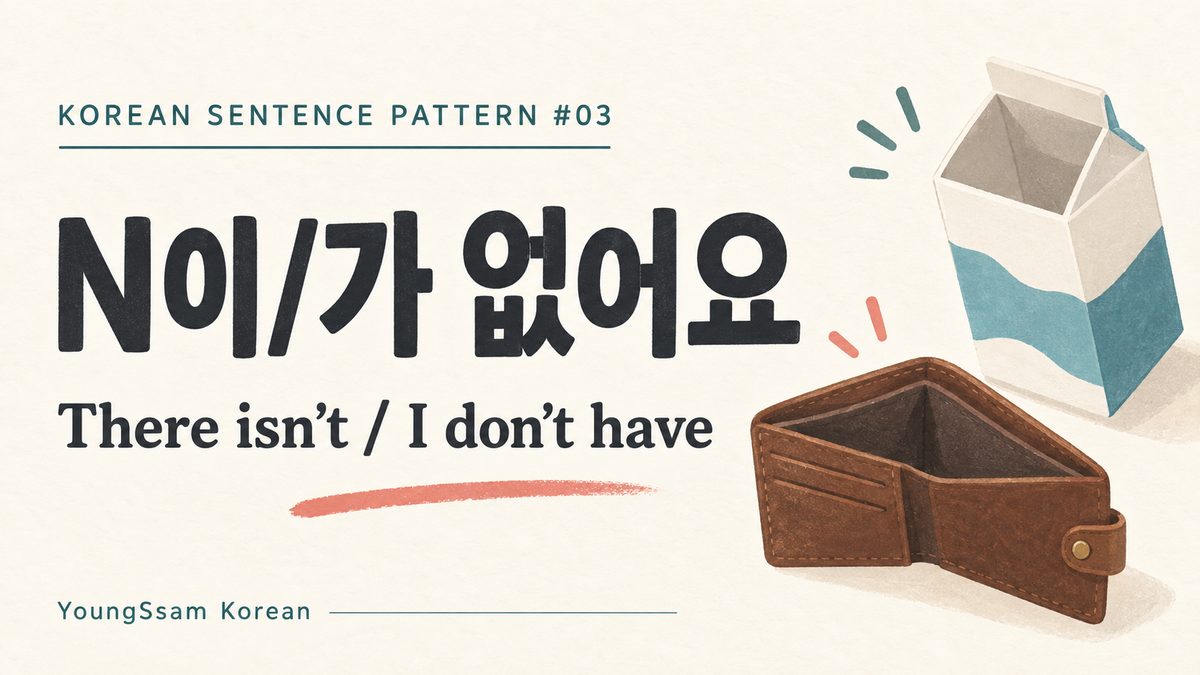
Learn to use N이/가 없어요 when something isn’t there or you don’t have something. Practice with everyday words, then make sentences that are true for you.
You’re ready to write, but you don’t have a pen. You open the fridge, but there’s no milk. A friend wants to chat, but you don’t have time.
In Korean, one pattern works for all three situations:
N이/가 없어요.
There is no N. / I don’t have N.
N means a noun—the person or thing you’re talking about.
Let’s start with something you might say during a busy day.
1. What does 없어요 mean?
Your friend asks if you have a few minutes. You have another meeting, so you say:
시간이 없어요.
I don’t have time.
Here are the pieces:
- 시간 = time
- 이 = a subject marker
- 없어요 = doesn’t exist / isn’t there
Korean describes time as something that isn’t available. In natural English, we say “I don’t have time.”
Now imagine you’re looking for milk in the fridge.
우유가 없어요.
There’s no milk.
The situation helps us understand the meaning. 우유가 없어요 could also mean “I don’t have any milk” if someone asks you for some.
2. From 있어요 to 없어요
In the previous lesson, you practiced 있어요. To express the opposite, replace it with 없어요.
| With 있어요 | With 없어요 |
|---|---|
| 시간이 있어요. — I have time. | 시간이 없어요. — I don’t have time. |
| 차가 있어요. — I have a car. | 차가 없어요. — I don’t have a car. |
| 우유가 있어요. — There’s milk. | 우유가 없어요. — There’s no milk. |
| 질문이 있어요. — I have a question. | 질문이 없어요. — I don’t have any questions. |
The noun and its marker stay the same. Only the ending changes.
없어요 already has a negative meaning, so you don’t need to add 안 to make this pattern negative.
시간이 없어요. ✓
시간이 안 없어요. ✗ For the meaning “I don’t have time.”
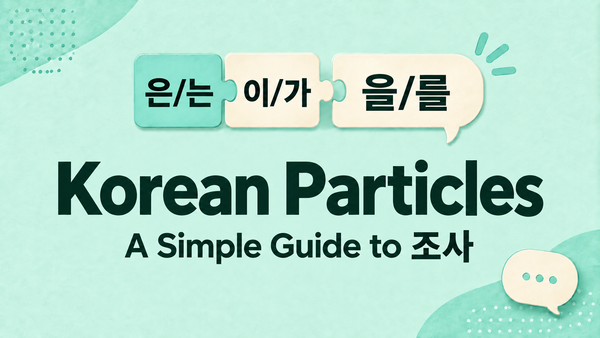
3. Choose 이 or 가
Look at the last syllable of your noun.
If it ends in a consonant (받침), use 이.
- 돈 → 돈이 없어요. — I don’t have money.
- 펜 → 펜이 없어요. — I don’t have a pen.
- 약속 → 약속이 없어요. — I don’t have any plans.
If it ends in a vowel, use 가.
- 차 → 차가 없어요. — I don’t have a car.
- 우유 → 우유가 없어요. — There’s no milk.
- 휴지 → 휴지가 없어요. — There’s no toilet paper.
Keep a space before 없어요:
펜이 없어요. ✓
펜이없어요. ✗
4. Pick a word from your day
What’s something you don’t have right now?
Try one of these nouns:
| Noun | Meaning | Sentence |
|---|---|---|
| 시간 | time | 시간이 없어요. |
| 돈 | money | 돈이 없어요. |
| 현금 | cash | 현금이 없어요. |
| 우산 | umbrella | 우산이 없어요. |
| 충전기 | charger | 충전기가 없어요. |
| 차 | car | 차가 없어요. |
| 질문 | question | 질문이 없어요. |
Imagine when you would use your sentence.
At a store that only accepts cash:
현금이 없어요.
I don’t have any cash.
When your phone battery is low:
충전기가 없어요.
I don’t have a charger.
When your teacher asks if you have questions:
질문이 없어요.
I don’t have any questions.
Choose one sentence you could use today, and say it aloud.
5. Talking about yourself with 저는
You can put 저는 at the beginning when you want to identify yourself as the topic.
저는 차가 없어요.
I don’t have a car.
저 means “I” or “me.” 는 marks the topic.
A literal way to understand this is “As for me, a car doesn’t exist.” The natural English meaning is “I don’t have a car.”
Notice that 차 takes 가, even though English uses “a car” as the object of “have.”
저는 차가 없어요. ✓
저는 차를 없어요. ✗
If the conversation already makes it clear that you’re talking about yourself, you can simply say:
차가 없어요.
I don’t have a car.
6. Say what’s missing from a place
Maybe you have milk at home, but there’s none in the office fridge. Add a location to make your meaning more specific.
Place + 에 + N이/가 없어요.
에 tells us where something is—or, here, where it isn’t.
냉장고에 우유가 없어요.
There’s no milk in the fridge.
방에 에어컨이 없어요.
There’s no air conditioner in the room.
화장실에 휴지가 없어요.
There’s no toilet paper in the bathroom.
You can use this when you check a room, look for supplies, or explain what you need.
7. Use 없어요 in a conversation
A useful way to practice is to answer questions with 있어요.
Borrowing something
A: 우산이 있어요?
Do you have an umbrella?B: 아니요, 우산이 없어요.
No, I don’t have an umbrella.
Making plans
A: 오늘 시간이 있어요?
Do you have time today?B: 아니요, 오늘은 시간이 없어요.
No, I don’t have time today.
Checking what’s available
A: 냉장고에 우유가 있어요?
Is there any milk in the fridge?B: 아니요, 우유가 없어요.
No, there isn’t any milk.
Once the noun is clear, a shorter answer works too:
아니요, 없어요.
No, I don’t. / No, there isn’t.
8. What about 없어요?
With rising intonation, 없어요? becomes a question.
시간이 없어요?
You don’t have time?
우유가 없어요?
Is there no milk?
You might ask this to check that something is unavailable, or because you expected it to be there.
Compare:
우유가 있어요?
Is there any milk?우유가 없어요?
Is there no milk?
For your first conversations, practice asking with 있어요? and answering with either 있어요 or 없어요.
9. Make three sentences about your life
Complete these prompts with your own words.
- Something you don’t have:
저는 __________이/가 없어요. - Something that isn’t in your room:
제 방에 __________이/가 없어요. - Something you don’t have today:
오늘은 __________이/가 없어요.
Here’s one possible set:
저는 자전거가 없어요.
I don’t have a bicycle.
제 방에 텔레비전이 없어요.
There’s no TV in my room.
오늘은 약속이 없어요.
I don’t have any plans today.
Read your sentences aloud. Then look away and try saying them again.
10. Combine what you have and what you don’t have
You can now use two patterns to describe your life more fully.
차가 없어요. 자전거가 있어요.
I don’t have a car. I have a bicycle.
커피가 있어요. 우유가 없어요.
There’s coffee. There’s no milk.
오늘은 시간이 없어요. 내일은 시간이 있어요.
I don’t have time today. I have time tomorrow.
What would your two sentences be?
Choose something you have and something you don’t have. Say both in Korean—and you’ve made a small conversation about your own life.
Keep Building Your Korean
Get a simple Korean lesson in your inbox every week. Learn a useful sentence pattern, make it your own, and practice saying something about your life.