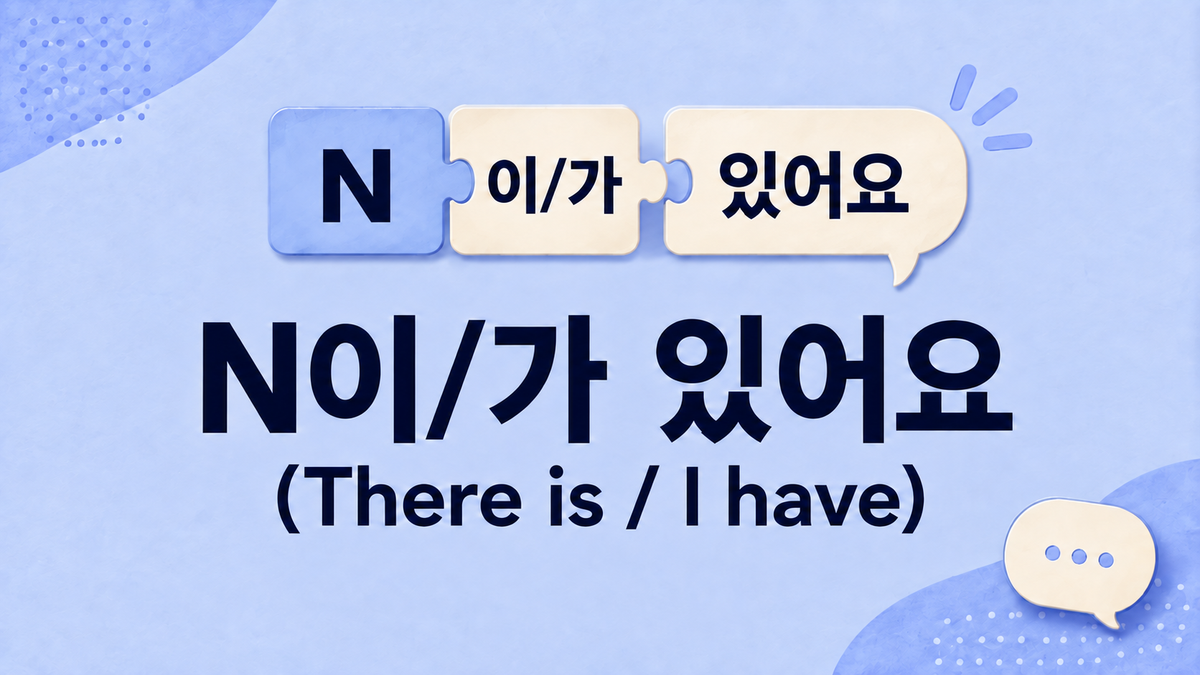
[Korean Sentence Pattern #02] N이/가 있어요 (There is / I have)
Learn how to use N이/가 있어요 to talk about what you have and what exists around you. Then replace the noun to build Korean sentences about your own life.

Want to talk about what’s around you—or what you have—in Korean?
Start with one simple sentence pattern, then change the noun to say something about your own life.
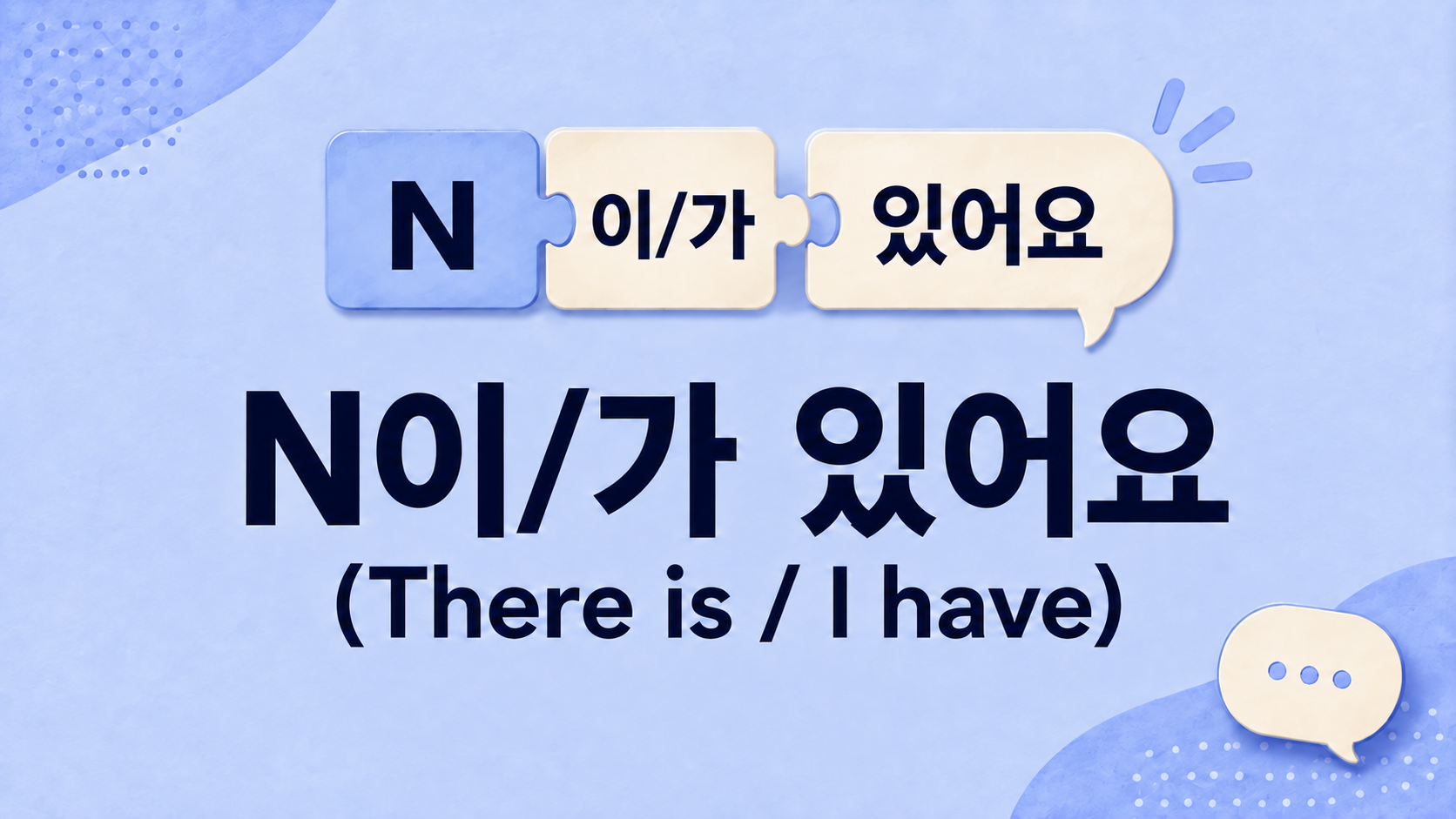
N이/가 있어요.
There is/are N. / I have N.
N stands for a noun. You can use this pattern for water, coffee, time, friends, and much more.
Start with this sentence
Imagine you’re pointing out some water on a table.
물이 있어요.
There is water.
Let’s break it into three parts:
- 물 = water
- 이 = marks 물 as the subject
- 있어요 = exists / is there
물 + 이 becomes 물이. Add 있어요, and you have a complete sentence.
Now imagine someone asks whether you have time to talk.
시간이 있어요.
I have time.
The pattern is the same: noun + 이/가 + 있어요. English uses “there is” in the first example and “I have” in the second.
The meaning depends on the situation. 물이 있어요 can also mean “I have water”—for example, when someone asks whether you have any water with you. You don’t need a different Korean pattern for each English translation.
The sentence-building pattern
Use this frame:
N + 이/가 + 있어요.
Start with the thing you want to talk about, then add 이/가 있어요.
- 물 → 물이 있어요. — There is water.
- 커피 → 커피가 있어요. — There is coffee.
- 시간 → 시간이 있어요. — I have time.
- 질문 → 질문이 있어요. — I have a question.
These English translations fit common situations. The conversation tells you whether someone means “there is” or “I have.”
You are not memorizing four separate sentences. You are learning one pattern and changing the word inside it.
이 or 가?
이/가 marks the noun as the subject in this pattern. Your choice depends on whether the noun ends with a final consonant.
After a final consonant: 이
The final consonant at the bottom of a Korean syllable is called 받침. If the noun has 받침, add 이.
- 물 → has 받침 ㄹ → 물이 있어요.
- 시간 → has 받침 ㄴ → 시간이 있어요.
- 책 → has 받침 ㄱ → 책이 있어요.
물이 있어요.
There is water.
책이 있어요.
There is a book.
After a vowel: 가
If the noun has no 받침, add 가.
- 커피 → no 받침 → 커피가 있어요.
- 친구 → no 받침 → 친구가 있어요.
- 고양이 → no 받침 → 고양이가 있어요.
커피가 있어요.
There is coffee.
고양이가 있어요.
I have a cat.
Here is the quick rule:
받침 O → 이
받침 X → 가
Don’t stop for too long to calculate the rule while speaking. With repeated practice, the correct form will begin to sound natural.
Now make the sentence yours
Choose something around you or something you have.
Words you can use
- 물 — water
- 커피 — coffee
- 책 — book
- 시간 — time
- 돈 — money
- 질문 — question
- 친구 — friend
- 동생 — younger sibling
- 차 — car
- 강아지 — dog
- 고양이 — cat
Now put your word into the frame:
__________이/가 있어요.
For example, when talking about what you have:
돈이 있어요.
I have money.
친구가 있어요.
I have a friend.
동생이 있어요.
I have a younger sibling.
질문이 있어요.
I have a question.
Which sentence is true for you?
Do I need to say 저는?
You can add 저는 to make it clear that you’re talking about yourself.
시간이 있어요.
I have time.
저는 시간이 있어요.
As for me, I have time.
저 means “I” or “me,” and 는 marks the topic—what or who the sentence is about.
Notice the difference from English. In “I have time,” time is the object of “have.” In Korean, 시간 takes the subject marker 이 with 있어요.
시간이 있어요. ✓
시간을 있어요. ✗
Think of 저는 시간이 있어요 as “As for me, time exists.” The natural English translation is simply “I have time.”
When it’s clear who you’re talking about, you can leave 저는 out. 시간이 still has its subject marker.
The same works with other nouns:
저는 차가 있어요. → 차가 있어요.
I have a car.
저는 고양이가 있어요. → 고양이가 있어요.
I have a cat.
You don’t need to add 저는 every time. Start with N이/가 있어요, and add 저는 when it helps make your meaning clear.
Talk about what exists somewhere
You can also add a place to say where something is.
Use this frame:
Place + 에 + N이/가 있어요.
There is/are N in/at + place.
Here, 에 marks the location.
냉장고에 물이 있어요.
There is water in the fridge.
방에 침대가 있어요.
There is a bed in the room.
책상 위에 책이 있어요.
There is a book on the desk.
The basic pattern is still N이/가 있어요. You are simply adding a place in front of it.
Ask someone a question
You can turn the same pattern into a question with rising intonation.
물이 있어요?
Is there any water? / Do you have any water?
시간이 있어요?
Do you have time?
고양이가 있어요?
Do you have a cat?
Try answering with today’s pattern:
시간이 있어요?
네, 시간이 있어요.
Yes, I have time.
고양이가 있어요?
네, 고양이가 있어요.
Yes, I have a cat.
You don’t need 저는 in these answers. The question already makes it clear who you’re talking about.
Your turn: build three sentences
Use today’s pattern to say something true about your life.
- Say something you have: __________이/가 있어요.
- Say something in your room: 제 방에 __________이/가 있어요.
- Ask someone a question: __________이/가 있어요?
For example:
자전거가 있어요.
I have a bicycle.
제 방에 책상이 있어요.
There is a desk in my room.
시간이 있어요?
Do you have time?
Then say each sentence aloud three times.
First, read it slowly.
Next, say it without looking.
Finally, replace the noun with another word from your own life.
One pattern, your Korean
A textbook might give you this sentence:
강아지가 있어요.
I have a dog.
But what if you don’t have a dog?
Keep the pattern and replace the noun:
고양이가 있어요.
I have a cat.
Start with N이/가 있어요. Add 저는 or a place when you need it, and build a sentence you can actually use.
Build your own sentence. Speak YOUR Korean, not textbook Korean.
Put Your Korean into Practice
Join YoungSsam Korean Club on Circle to practice with other learners, ask questions, and get feedback from me. Bring one sentence using N이/가 있어요 and start practicing!
Join YoungSsam Korean Club →