Sino-Korean Numbers: When to Use Them and How to Read Big Numbers
Learn when to use Sino-Korean numbers, build numbers beyond 10, and read large numbers with 만 and 억. Includes everyday examples, the rules for dropping 일, and a quick practice quiz.

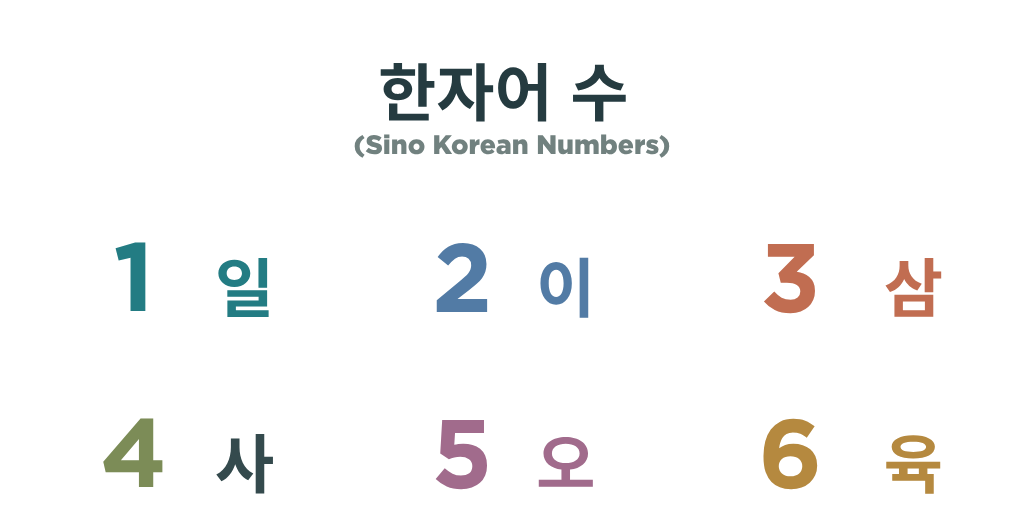
Korean has two number systems: Sino-Korean numbers (일, 이, 삼) and native Korean numbers (하나, 둘, 셋).
In this guide, we’ll focus on 한자어 수, or Sino-Korean numbers—the numbers you use for prices, dates, minutes, phone numbers, and more. Once you know 1–10 and a few place-value words, you can build your way up to 100 million!
When do you use Sino-Korean numbers?
You’ll hear Sino-Korean numbers in these everyday situations:
- Prices: 3,500원 → 삼천오백 원 (3,500 won)
- Dates: 9월 17일 → 구 월 십칠 일 (September 17)
- Years: 2026년 → 이천이십육 년
- Minutes and seconds: 20분 30초 → 이십 분 삼십 초
- Floor numbers: 3층 → 삼 층 (the third floor)
- Phone numbers: 010 → 공일공 (read each digit separately)
Watch out when telling the time! In everyday 12-hour time expressions, use native Korean numbers for the hour and Sino-Korean numbers for the minutes: 3시 20분 → 세 시 이십 분.
A small date exception: June is 유월, and October is 시월.
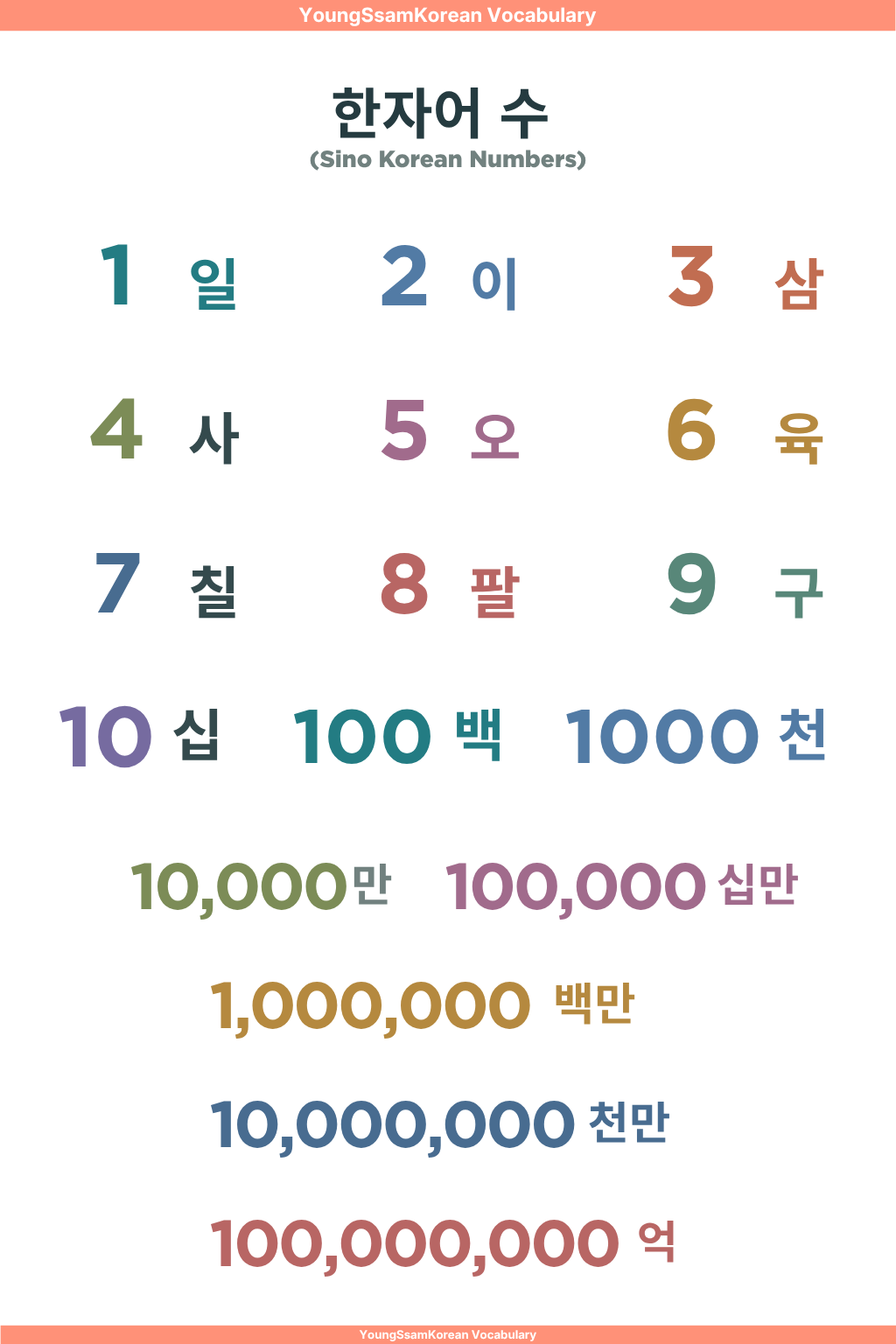
Start with 1–10
1 일 · 2 이 · 3 삼 · 4 사 · 5 오
6 육 · 7 칠 · 8 팔 · 9 구 · 10 십
These are your building blocks. You don’t need a new word for every number after ten—you combine the words you already know.
How to read numbers after 10
11–19: 십 + the ones digit
- 11 → 십 + 일 → 십일
- 12 → 십 + 이 → 십이
- 15 → 십 + 오 → 십오
- 19 → 십 + 구 → 십구
20, 30, 40…: a number + 십
Put a number before 십 to show how many tens you have.
- 20 → 이 × 십 → 이십
- 30 → 삼 × 십 → 삼십
- 50 → 오 × 십 → 오십
- 90 → 구 × 십 → 구십
Now combine the tens and ones:
- 24 → 이십 + 사 → 이십사
- 37 → 삼십 + 칠 → 삼십칠
- 68 → 육십 + 팔 → 육십팔
- 99 → 구십 + 구 → 구십구
Hundreds and thousands: 백 and 천
100 is 백. 1,000 is 천. Read from the largest place value to the smallest.
- 200 → 이백 (two hundreds)
- 350 → 삼백오십 (three hundreds + five tens)
- 1,234 → 천이백삼십사
- 5,678 → 오천육백칠십팔
Skip any place with a zero. You don’t say a word for that empty place when reading the number’s value.
- 105 → 백 + 오 → 백오
- 1,020 → 천 + 이십 → 천이십
- 3,008 → 삼천 + 팔 → 삼천팔
Phone numbers work differently: you read the individual digits, including zeros. In phone numbers, zero is commonly read as 공.
Why say 십, not 일십?
In everyday number reading, drop 일 before 십, 백, and 천. You also normally say 만 for 10,000.
- 10 → 십, rather than 일십
- 100 → 백, rather than 일백
- 1,000 → 천, rather than 일천
- 10,000 → 만, rather than 일만
That’s why 1,110 is 천백십, and 11,111 is 만 천백십일. The final 일 stays because it represents the ones digit.
You may see forms such as 일천 or 일만 in formal written amounts. They are not always wrong; 십, 백, 천, and 만 are the natural starting point for everyday use.
The key to big Korean numbers: 만
English groups large numbers around thousands, millions, and billions. Korean uses major units that step up every four digits: 만 (10,000), then 억 (100,000,000).
Start by asking: “How many groups of 10,000 are there?”
- 10,000 → 만 (ten thousand)
- 100,000 → 십만 (one hundred thousand)
- 1,000,000 → 백만 (one million)
- 10,000,000 → 천만 (ten million)
- 100,000,000 → 일억 (one hundred million)
For example, 50,000 is five groups of 만, so it’s 오만. And 230,000 is twenty-three groups of 만, so it’s 이십삼만.
If there are digits left over, read them after 만:
- 35,000 → 삼만 오천
- 72,500 → 칠만 이천오백
- 123,456 → 십이만 삼천사백오십육
- 1,500,000 → 백오십만
A useful trick: ignore the printed commas for a moment and split the number into groups of four digits from the right.
123,456 → 12 | 3456
12 groups of 만 + 3,456
→ 십이만 삼천사백오십육
Keep 일 in 일억
Here’s an important difference: 100,000,000 is 일억. Unlike 십, 백, 천, and the usual 만, keep 일 when reading one hundred million.
- 100,000,000 → 일억
- 200,000,000 → 이억
- 1,000,000,000 → 십억 (one billion)
For a longer number, use the same four-digit grouping:
123,456,789 → 1 | 2345 | 6789
1 억 + 2,345 만 + 6,789
→ 일억 이천삼백사십오만 육천칠백팔십구
Read each small group first, then add its unit. You don’t have to work out the entire number at once.
Try reading these numbers
Say each number aloud before checking the answers: 16 / 48 / 109 / 2,350 / 45,000 / 320,000 / 1,000,000 / 100,000,000.
Answers
- 16 → 십육
- 48 → 사십팔
- 109 → 백구
- 2,350 → 이천삼백오십
- 45,000 → 사만 오천
- 320,000 → 삼십이만
- 1,000,000 → 백만
- 100,000,000 → 일억
These are the written forms; connected Korean speech can change how some sounds are pronounced. For example, 십육 is pronounced [심뉵].
For a little everyday practice, choose one price from a menu or receipt. 4,500원 is 사천오백 원, and 12,000원 is 만 이천 원. Start small and say the numbers out loud!
YoungSsam Korean Club
Keep learning Korean with us
Ready to put these numbers into practice? Join YoungSsam Korean Club on Circle and continue your Korean learning with our community.
Join YoungSsam Korean Club →