[Korean Sentence Pattern #05] N을/를 V-아요/어요 (Korean Object Particles)

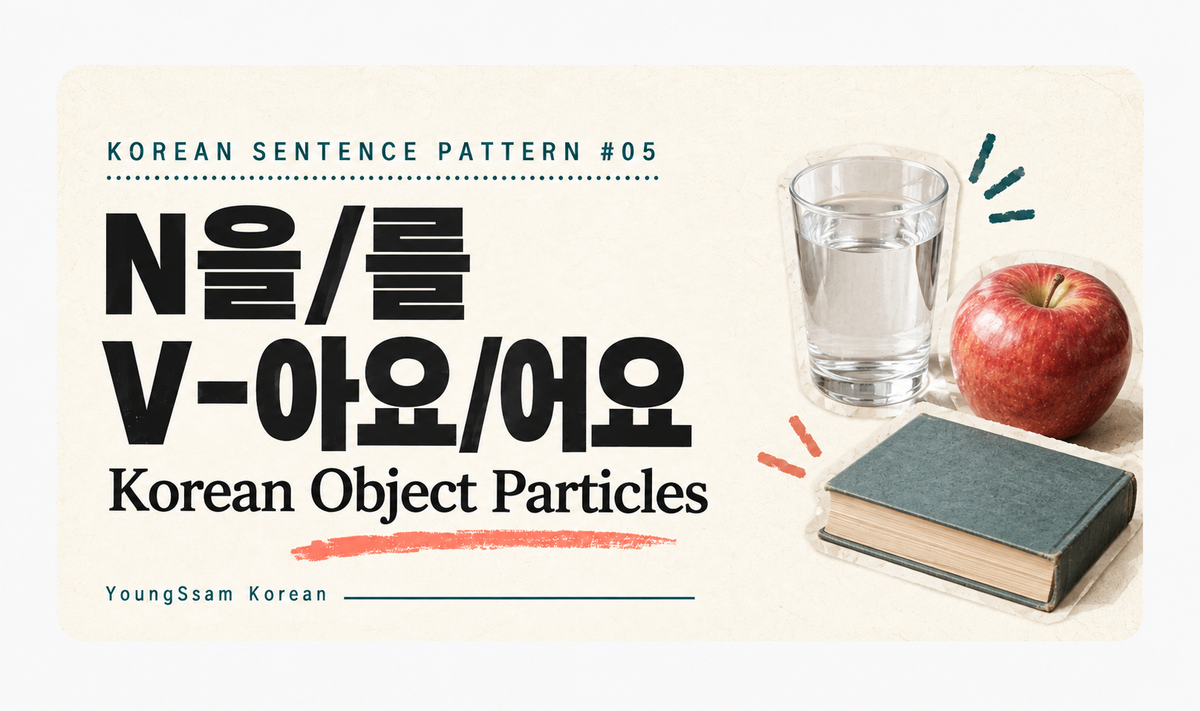
Learn to use 을/를 to say what you eat, drink, read, buy, and enjoy. Practice with everyday examples, then build sentences about your own life.
You drink water after a walk. You read a book before bed. You buy an apple at the store.
Each sentence has an action and something that the action is directed toward. In Korean, 을/를 helps show that connection.
물을 마셔요.
I drink water.
책을 읽어요.
I read a book.
사과를 사요.
I buy an apple.
The pattern is:
N을/를 + V-아요/어요.
N means a noun. V means a verb that takes an object, such as 먹다 (to eat), 읽다 (to read), or 사다 (to buy).
Need help making forms like 먹어요, 마셔요, and 사요? Read V/A -아요/어요: Everyday Polite Korean for the ending rules. Here, we’ll focus on 을/를 and the noun that comes before it.
1. What does 을/를 do?
Imagine someone asks what you eat for breakfast. You say:
저는 빵을 먹어요.
I eat bread.
Here are the pieces:
- 저는 = as for me / I
- 빵 = bread
- 을 = an object marker
- 먹어요 = eat
The action is 먹어요. What do you eat? 빵. That makes 빵 the object of the action.
을/를 attaches to the noun to mark that role. It doesn’t have a separate English translation.
Try the same question with another sentence:
영화를 봐요.
I watch a movie.
What do you watch? 영화. That is why 영화 takes 를.
An object can also be a person:
친구를 만나요.
I meet a friend.
Who do you meet? 친구. Here, 친구 is the object of 만나요.
2. Choose 을 or 를
을 and 를 do the same job. Your choice depends on the last syllable of the noun.
If the noun ends in a consonant (받침), use 을.
| Noun | Meaning | With 을 |
|---|---|---|
| 밥 | rice / a meal | 밥을 |
| 물 | water | 물을 |
| 책 | book | 책을 |
| 음악 | music | 음악을 |
| 옷 | clothes | 옷을 |
| 사진 | photo | 사진을 |
If the noun ends in a vowel, use 를.
| Noun | Meaning | With 를 |
|---|---|---|
| 커피 | coffee | 커피를 |
| 사과 | apple | 사과를 |
| 영화 | movie | 영화를 |
| 친구 | friend | 친구를 |
| 한국어 | Korean | 한국어를 |
| 편지 | letter | 편지를 |
Look at the Korean spelling, not the English meaning. 커피 ends in the vowel ㅣ, so it takes 를.
물을 마셔요.
I drink water.
커피를 마셔요.
I drink coffee.
The verb stays the same. The noun determines which object marker you use.
3. Put the object before the verb
English usually puts the object after the verb: “I read a book.”
For this Korean pattern, put the object before the verb:
저는 + 책을 + 읽어요.
Think of the order as “I + a book + read.”
저는 사과를 먹어요.
I eat an apple.
저는 한국어를 공부해요.
I study Korean.
저는 친구를 만나요.
I meet a friend.
When the conversation already makes it clear who you mean, you can leave out 저는:
한국어를 공부해요.
I study Korean.
Attach 을/를 directly to the noun, then leave a space before the verb:
책을 읽어요. ✓
책 을 읽어요. ✗
책을읽어요. ✗
4. Talk about food and drinks
Start with something you eat or drink often.
| Korean | English |
|---|---|
| 아침에 빵을 먹어요. | I eat bread in the morning. |
| 점심에 김밥을 먹어요. | I eat gimbap for lunch. |
| 저녁에 밥을 먹어요. | I eat a meal in the evening. |
| 바나나를 먹어요. | I eat a banana. |
| 물을 마셔요. | I drink water. |
| 우유를 마셔요. | I drink milk. |
| 아침에 커피를 마셔요. | I drink coffee in the morning. |
| 집에서 차를 마셔요. | I drink tea at home. |
Notice how 먹어요 works with both 빵을 and 바나나를. The marker changes because the noun changes, not because the action changes.
Try changing just the food:
빵을 먹어요. → 사과를 먹어요. → 김밥을 먹어요.
I eat bread. → I eat an apple. → I eat gimbap.
What do you usually have for breakfast? Make one sentence that is true for you.
5. Talk about studying, hobbies, and errands
을/를 works with many everyday actions.
| Situation | Korean | English |
|---|---|---|
| Reading | 책을 읽어요. | I read a book. |
| Reading the news | 뉴스를 읽어요. | I read the news. |
| Studying | 한국어를 공부해요. | I study Korean. |
| Doing homework | 숙제를 해요. | I do my homework. |
| Watching something | 드라마를 봐요. | I watch a drama. |
| Listening | 음악을 들어요. | I listen to music. |
| Taking pictures | 사진을 찍어요. | I take photos. |
| Shopping | 옷을 사요. | I buy clothes. |
| Choosing a gift | 선물을 골라요. | I choose a gift. |
| Meeting someone | 친구를 만나요. | I meet a friend. |
| Waiting | 버스를 기다려요. | I wait for the bus. |
| Opening something | 문을 열어요. | I open the door. |
English uses “to” in “listen to music” and “for” in “wait for the bus.” Korean uses an object marker with these verbs:
음악을 들어요.
I listen to music.
버스를 기다려요.
I wait for the bus.
Learn the noun and verb together as a useful phrase. You don’t need to translate each English word into a separate Korean word.
6. Keep the noun, change its role
The same noun can take a different marker when its job in the sentence changes.
Imagine a book on your desk:
책이 있어요.
There is a book. / I have a book.
Now imagine reading it:
책을 읽어요.
I read a book.
In the first sentence, 책 is what exists. In the second, 책 is what you read.
Compare a few more:
| Describing what exists or what something is like | Saying what you do with it |
|---|---|
| 물이 있어요. — There is water. | 물을 마셔요. — I drink water. |
| 사과가 맛있어요. — The apple is delicious. | 사과를 먹어요. — I eat an apple. |
| 영화가 재미있어요. — The movie is interesting. | 영화를 봐요. — I watch a movie. |
| 가방이 예뻐요. — The bag is pretty. | 가방을 사요. — I buy a bag. |
Don’t choose 을/를 just because you see a noun. Ask what that noun is doing in the sentence.
7. Why does this pattern say V, not V/A?
-아요/어요 can be used with both verbs and adjectives. But this object pattern needs a verb that takes an object.
An adjective such as 예뻐요 (is pretty) describes something. In a basic sentence like this, use 이/가 for the thing you’re describing:
꽃이 예뻐요. ✓
The flowers are pretty.
꽃을 예뻐요. ✗
A particularly useful pair is 좋다 and 좋아하다.
커피가 좋아요.
I like coffee. / Coffee is good.
커피를 좋아해요.
I like coffee.
Both can express a preference, but their grammar is different. 좋다 is an adjective; 좋아하다 is a verb that takes an object.
For now, practice these combinations together:
N이/가 좋아요.
N을/를 좋아해요.
Also, not every action verb needs an object. For the simple meaning “I go to school,” use 학교에 가요. 학교 is your destination, so this sentence uses 에.
8. Use 을/를 in a conversation
To ask what someone eats, reads, or buys, use 뭐를 or its common shortened form, 뭘.
At lunchtime
A: 점심에 뭘 먹어요?
What do you eat for lunch?
B: 김밥을 먹어요.
I eat gimbap.
Talking about a quiet evening
A: 집에서 뭘 해요?
What do you do at home?
B: 책을 읽어요. 음악을 들어요.
I read books. I listen to music.
At a store
A: 뭘 사요?
What are you buying?
B: 친구 선물을 사요.
I’m buying a gift for a friend.
Making plans
A: 오늘 누구를 만나요?
Who are you meeting today?
B: 친구를 만나요.
I’m meeting a friend.
누구 means “who.” Because it ends in a vowel, it takes 를: 누구를.
You may also hear 커피 마셔요 or 뭐 먹어요? in everyday speech. Speakers often leave out 을/를 when the meaning is clear. Keep it in your practice sentences while you learn how the pattern works.
9. Try a quick 을/를 check
Fill in each blank with 을 or 를. Look at the last syllable of the noun.
- 물___ 마셔요. — I drink water.
- 사과___ 먹어요. — I eat an apple.
- 한국어___ 공부해요. — I study Korean.
- 음악___ 들어요. — I listen to music.
- 사진___ 찍어요. — I take photos.
- 친구___ 만나요. — I meet a friend.
Then choose the sentence that means “I like coffee.”
- 커피를 좋아해요.
- 커피를 좋아요.
Check your answers
- 물을 마셔요.
- 사과를 먹어요.
- 한국어를 공부해요.
- 음악을 들어요.
- 사진을 찍어요.
- 친구를 만나요.
The correct choice is 커피를 좋아해요. If you use 좋아요 instead, say 커피가 좋아요.
Read each complete sentence aloud. Notice the noun and its marker together: 물을, 사과를, 한국어를.
10. Make three sentences about your life
Choose words that fit your day.
- Something you eat or drink: 저는 __________을/를 __________.
- Something you read, watch, or listen to: 저는 __________을/를 __________.
- Someone you meet or something you buy: 저는 __________을/를 __________.
Here’s one possible set:
아침에 커피를 마셔요.
I drink coffee in the morning.
저녁에 드라마를 봐요.
I watch dramas in the evening.
주말에 친구를 만나요.
I meet friends on weekends.
Say your sentences aloud. Then look away and try saying them again.
To make a new sentence, change just the noun:
커피를 마셔요. → 물을 마셔요.
I drink coffee. → I drink water.
Check the last syllable each time. A new noun might need a different marker.
What do you eat, read, or enjoy today? Choose a noun, add 을 or 를, and finish with your action.
Keep Building Your Korean
Need another look at the verb endings? Review V/A -아요/어요: Everyday Polite Korean, then come back and try three new object sentences.