Korean Body Parts: A Complete Guide to 31 Essential Words
Learn 31 Korean body part words from head to toe with clear vocabulary tables, English meanings, and everyday example sentences. Practice key differences such as 머리 vs. 머리카락 and 손목 vs. 발목.

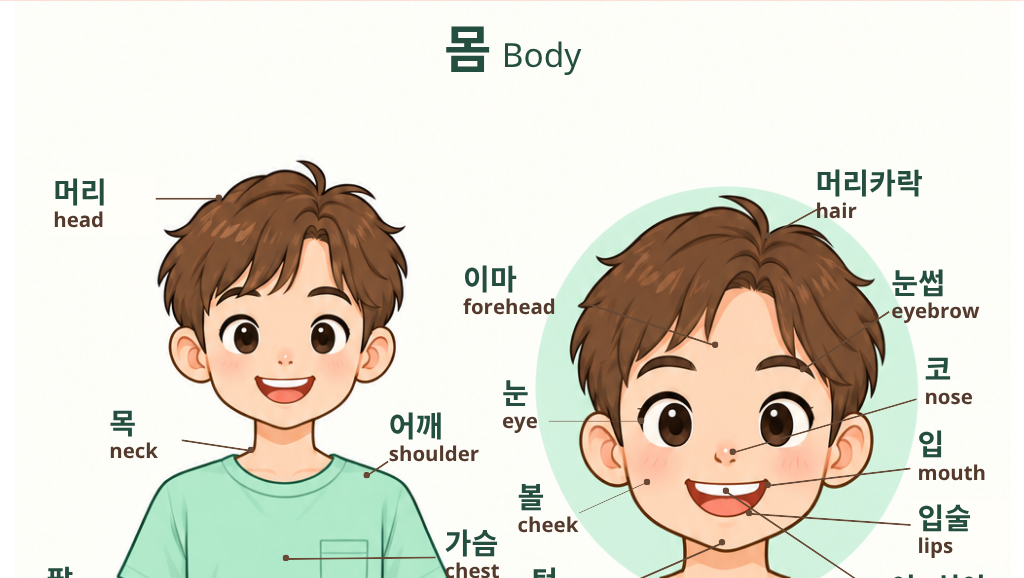
Want to learn the names of body parts in Korean? This guide introduces 31 useful Korean words, from your head to your toes, with English meanings and simple sentences you can practice.
신체 부위 means “body parts.” 몸 is the everyday Korean word for “body.” Read each Korean word aloud and point to the same part on your own body.
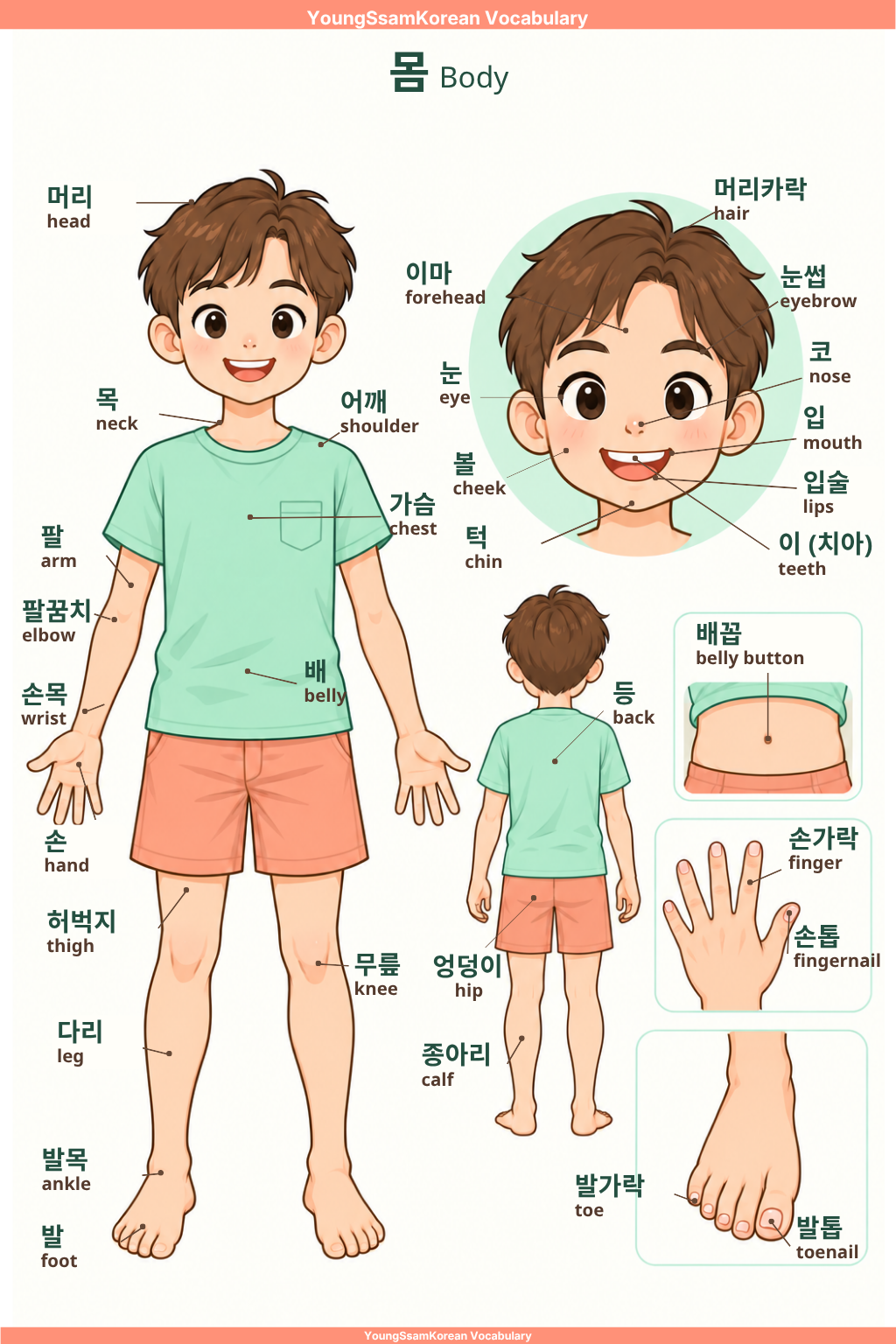
Head and Face in Korean
| Korean | English |
|---|---|
| 머리 | head |
| 머리카락 | hair |
| 이마 | forehead |
| 눈썹 | eyebrow |
| 눈 | eye |
| 코 | nose |
| 입 | mouth |
| 입술 | lips |
| 이 / 치아 | tooth, teeth |
| 볼 | cheek |
| 턱 | chin |
머리 vs. 머리카락
머리 means “head,” while 머리카락 means “hair.” In everyday Korean, however, 머리 can also refer to your hair. For example, “머리를 잘랐어요” means “I got a haircut.”
입 vs. 입술
입 means “mouth,” and 입술 means “lips.” 윗입술 is the upper lip, and 아랫입술 is the lower lip.
이 vs. 치아
Both 이 and 치아 refer to teeth. 이 is common in everyday expressions such as “이를 닦아요” (“Brush your teeth”). You’ll also frequently see 치아 in dental and health information.
In this vocabulary list, 턱 refers to the chin. Depending on context, 턱 can also refer to the jaw.
Practice Sentences
- 눈을 감아요. — Close your eyes.
- 입을 벌려요. — Open your mouth.
- 이를 닦아요. — Brush your teeth.
Neck and Torso in Korean
| Korean | English |
|---|---|
| 목 | neck |
| 어깨 | shoulder |
| 가슴 | chest |
| 배 | belly |
| 배꼽 | belly button |
| 등 | back |
배 refers to your belly, and 배꼽 is your belly button. 등 refers to the back of your torso.
The word 목 can mean either “neck” or “throat.” Depending on the context, “목이 아파요” can mean “My neck hurts” or “I have a sore throat.”
Practice Sentences
- 어깨를 올려요. — Raise your shoulders.
- 배가 아파요. — My stomach hurts.
- 등을 펴요. — Straighten your back.
Arms and Hands in Korean
| Korean | English |
|---|---|
| 팔 | arm |
| 팔꿈치 | elbow |
| 손목 | wrist |
| 손 | hand |
| 손가락 | finger |
| 손톱 | fingernail |
팔꿈치 is your elbow, where your arm bends. 손목 is your wrist, where your hand connects to your arm.
손 refers to the whole hand, while 손가락 refers to a finger. A fingernail is called 손톱.
Practice Sentences
- 팔을 들어요. — Raise your arm.
- 손을 씻어요. — Wash your hands.
- 손톱을 깎아요. — Trim your fingernails.
Legs and Feet in Korean
| Korean | English |
|---|---|
| 허벅지 | thigh |
| 종아리 | calf |
| 다리 | leg |
| 무릎 | knee |
| 발목 | ankle |
| 발 | foot |
| 발가락 | toe |
| 발톱 | toenail |
허벅지 is the upper part of your leg, above the knee. 종아리 refers to the back of your lower leg. 발목 is your ankle, where your leg connects to your foot.
Learn these matching pairs together: 손목 / 발목 (wrist / ankle), 손가락 / 발가락 (finger / toe), and 손톱 / 발톱 (fingernail / toenail).
Practice Sentences
- 무릎을 굽혀요. — Bend your knees.
- 발을 씻어요. — Wash your feet.
- 발가락을 움직여요. — Move your toes.
Do Korean Body Part Words Need Plural Forms?
In English, you distinguish between eye and eyes, or foot and feet. In Korean, you usually don’t need to mark body part words as plural.
- 눈을 감아요. can refer to closing both eyes.
- 손을 씻어요. can refer to washing both hands.
When you want to be explicit, you can say 두 눈 (“two eyes”), 두 손 (“two hands”), or 두 발 (“two feet”). 양손 means “both hands,” and 양발 means “both feet.”
How to Practice Korean Body Parts Vocabulary
Cover the English meanings in the tables and try naming each body part in Korean. Once you feel comfortable, practice with these questions:
- 코가 어디예요? — Where is your nose?
- 팔꿈치가 어디예요? — Where is your elbow?
- 무릎이 어디예요? — Where is your knee?
Point to the correct part and answer:
- 여기가 코예요. — Here is my nose.
- 여기가 팔꿈치예요. — Here is my elbow.
- 여기가 무릎이에요. — Here is my knee.
Choose five words to practice today. Connect them with everyday actions: say 손 when washing your hands and 이 when brushing your teeth. These small moments give you a simple way to practice Korean throughout the day.