Family words in Korean - How to call my family members

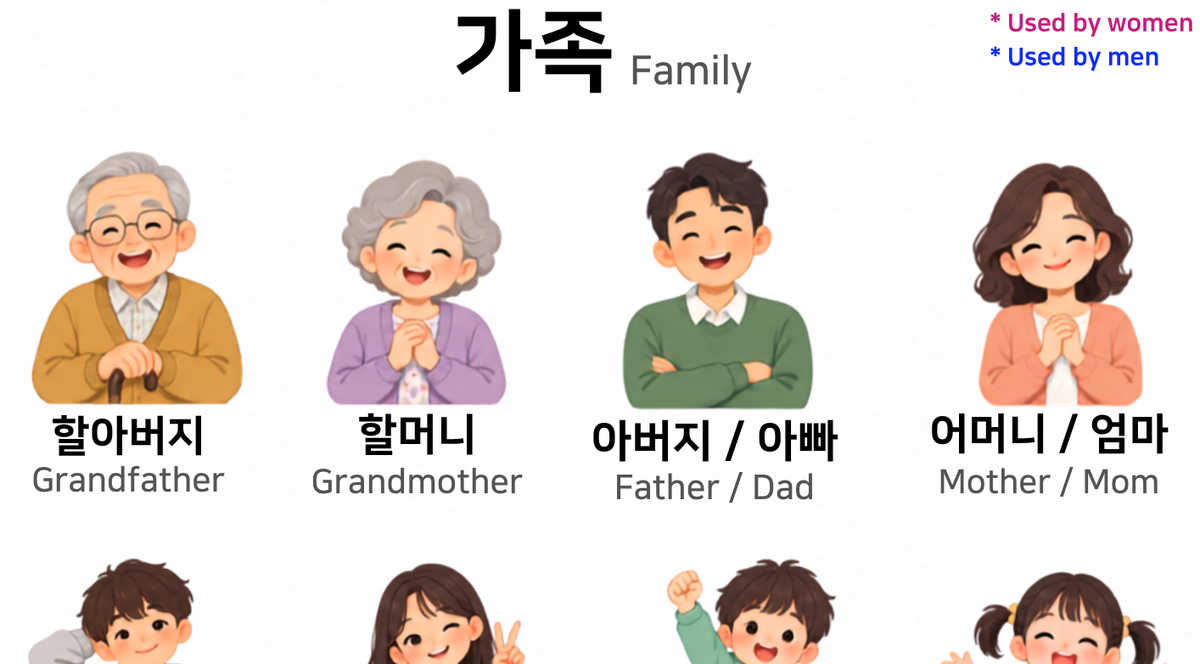
What do you call your family members in Korean?
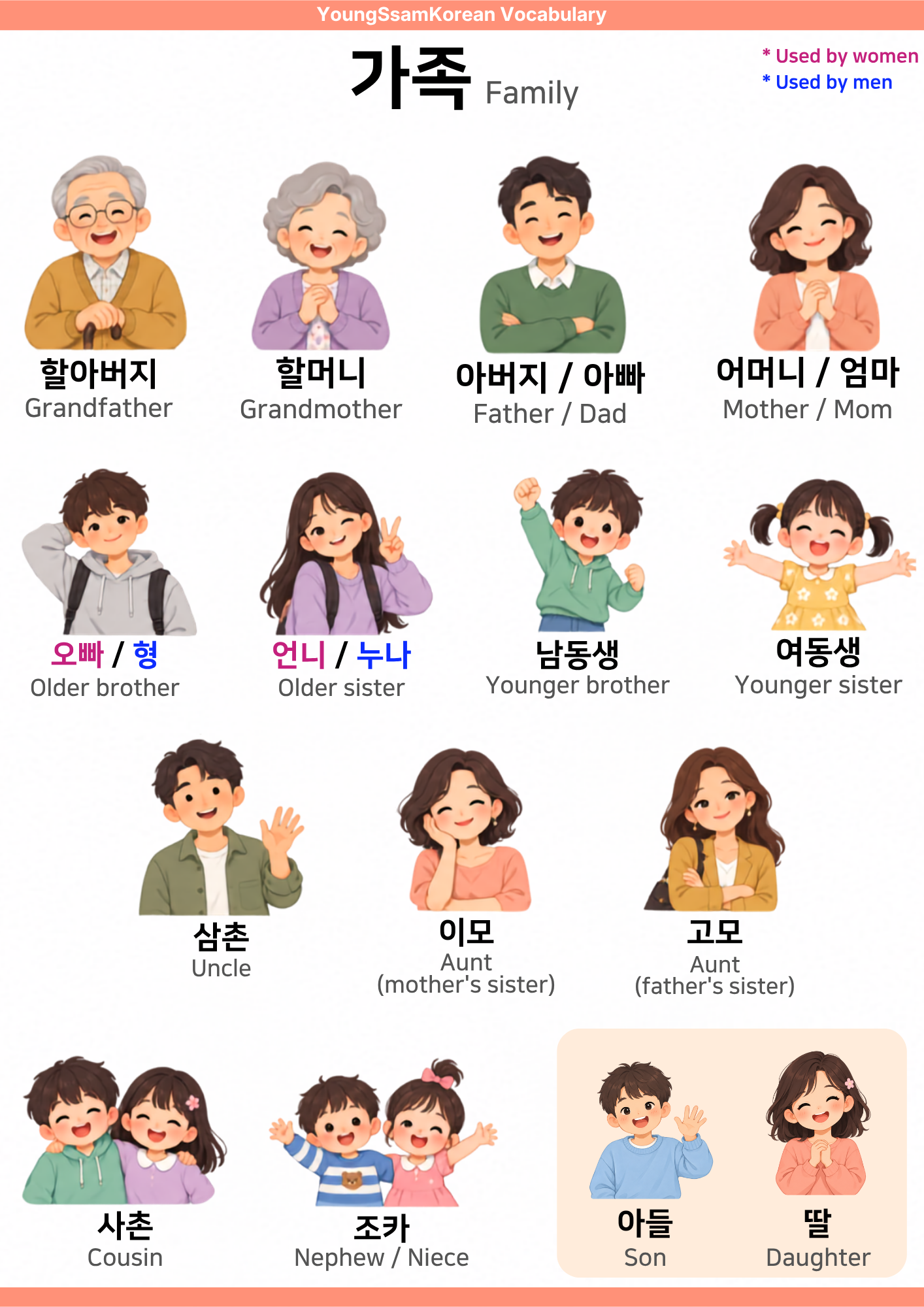
I’ve put together an illustrated vocabulary guide covering basic family words, immediate family, and close relatives up to first cousins. Along with the words, let’s explore how Koreans actually address their family members.
1. Use family titles instead of names
In Korea, people often use family titles rather than first names when speaking to their relatives.
This is especially common when addressing someone older than you or from an older generation, such as an aunt or uncle. Younger siblings, nieces, and nephews are usually called by their names.
- 엄마, 어디 가요? — Mom, where are you going?
- 삼촌, 안녕하세요! — Hello, Uncle!
- 지수야, 같이 놀자! — Jisu, let’s play together!
If several relatives share the same title, you can add a name before the title:
- 지수 이모 — Aunt Jisu
- 준호 형 — Older brother Junho (said by a male speaker)
The title still matters. Calling someone “준호!” feels different from calling him “준호 형!” when he is older than you.
You may also hear titles with words that indicate birth order:
- 둘째 삼촌 — the second uncle in birth order
- 셋째 누나 — the third older sister in birth order
Families also use words like 큰이모 and 작은이모 to distinguish between a mother’s older and younger sisters. Here, 큰 (“big”) and 작은 (“small”) refer to age or family order, not physical size. The exact naming pattern can vary from family to family.
2. 형 or 오빠? 누나 or 언니?
This is one of the trickiest parts for beginners: the words for older siblings depend on the gender of the person speaking.
- A male speaker calls
his older brother 형 (hyeong) and his older sister 누나 (nuna). - A female speaker calls
her older brother 오빠 (oppa) and her older sister 언니 (eonni).
For example, the same older brother is “형” to his younger brother and “오빠” to his younger sister.
For younger siblings, everyone uses 남동생 (younger brother) and 여동생 (younger sister), regardless of the speaker’s gender. These words describe the relationship; when calling a younger sibling directly, you would usually use their name.
3. Family words aren’t just for family
Koreans sometimes use family titles with people they are close to, even when they aren’t related.
A child might call their mom’s close friend 이모 (“aunt”), or call a familiar adult man 삼촌 (“uncle”). Close friends also use 언니, 누나, 오빠, and 형 for someone older than themselves.
You may hear these words between couples, too. For example, a woman might call her older boyfriend “오빠.” But not every couple uses this title.
These words can express closeness, but that doesn’t mean you should use them with someone you’ve just met. Pay attention to your relationship and what the other person feels comfortable being called.
You may hear people call a middle-aged or older female restaurant worker “이모” or “이모님.”
Here, it is a friendly form of address, not a literal family relationship. However, not everyone likes this title, and how it is received depends on the person and the setting.
“저기요” is also a common way to get a server’s attention. The word itself isn’t necessarily rude—your tone and the situation matter.
If you’re unsure what to say, try “저기요, 주문할게요” (“Excuse me, I’d like to order”) or “실례합니다” (“Excuse me”).
4. There are more words for extended family
Korean family titles can describe relationships in quite a lot of detail. The word you use may change depending on whether the relative is on your father’s side or your mother’s side.
For example, your father’s sister is 고모, while your mother’s sister is 이모.
Korean also has a concept called 촌수 (chonsu), which counts the steps between relatives in a family tree. A parent and child are 1촌 apart, siblings are 2촌 apart, you and your parent’s sibling are 3촌 apart, and first cousins are 4촌 apart.
Marriage brings another set of family relationships and titles. The words for in-laws depend on the exact relationship and sometimes on the gender of the person speaking, so there is a little more to learn.
We’ll explore these extended-family and in-law terms in a future vocabulary guide. For now, use the illustrations to focus on who is speaking and who they are speaking to!
Keep learning with YoungSsam Korean Club
Ready to put these family words into practice? Join me in our Circle community and keep building your Korean, one conversation at a time. Start by telling us about your family!
![[Korean Sentence Pattern #05] N을/를 V-아요/어요 (Korean Object Particles)](https://storage.ghost.io/c/3e/77/3e77e67a-c356-4231-b7c2-8a02146832bb/content/images/size/w600/2026/10/eul-reul-feature.png)
![[Korean Sentence Pattern #04] V/A -아요/어요 (Everyday Polite Korean)](https://storage.ghost.io/c/3e/77/3e77e67a-c356-4231-b7c2-8a02146832bb/content/images/size/w600/2026/10/ayo-eoyo-feature-v2.png)
![[Korean Sentence Pattern #03] N이/가 없어요 (There isn’t / I don’t have)](https://storage.ghost.io/c/3e/77/3e77e67a-c356-4231-b7c2-8a02146832bb/content/images/size/w600/2026/09/-----------------------------------1.Png)