Easy Korean Podcast Ep. 1: Korean Food Story 한국 음식 이야기
Listen to a slow Korean story about popular Korean food and restaurant culture, with practical expressions and a free transcript.

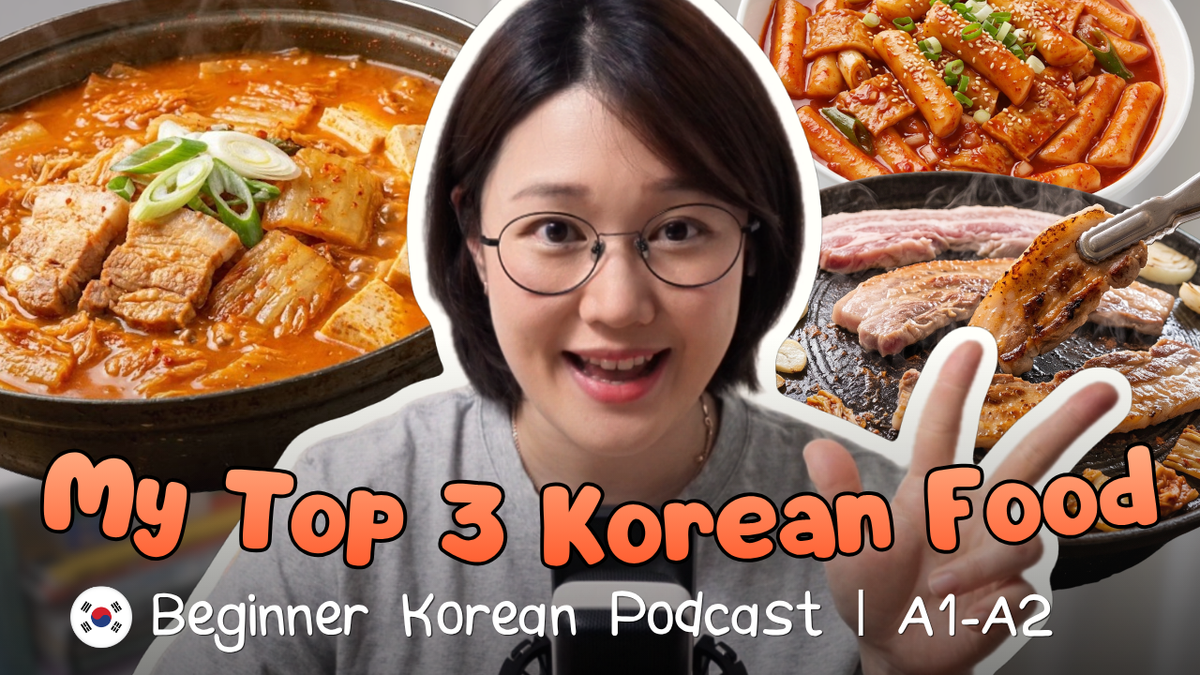
Welcome to the first episode of YoungSsam’s Korean Podcast! In this slow and beginner-friendly Korean listening practice, we talk about something everyone can enjoy: Korean food.
You’ll hear about my three favorite Korean dishes, a few things that surprise visitors at Korean restaurants, and simple Korean meals you can make at home.
Watch and listen to Episode 1 on YouTube →
What you’ll hear in this episode
- My three favorite Korean foods: 김치찌개, 삼겹살, and 떡볶이
- Korean restaurant culture: free side dishes, sharing food, metal chopsticks, and spicy-food levels
- Easy food to make at home: Korean ramyeon and bibimbap
Key Korean words and expressions
음식 — food
오늘 첫 번째 에피소드의 주제는 음식이에요.
Today, the topic of our first episode is food.
찌개 — Korean stew
한국에는 찌개의 종류가 진짜 많아요.
There are so many kinds of jjigae in Korea.
Common examples include 김치찌개, 된장찌개, and 순두부찌개.
반찬 — side dishes
반찬은 다 공짜예요!
The side dishes are all free!
At many Korean restaurants, several small side dishes arrive with the main meal. If you want more kimchi, you can say:
김치 좀 더 주세요.
Please give me some more kimchi.
덜다 — to serve or transfer food onto a plate
국물은 각자 덜어서 먹어요.
Each person serves some soup into their own bowl.
매워요 — it is spicy
A useful question when ordering Korean food is:
많이 매워요?
Is it very spicy?
Koreans sometimes explain the spice level by comparing it to familiar ramyeon:
신라면이랑 비슷하게 매워요.
It’s about as spicy as Shin Ramyun.
불닭볶음면 정도예요.
It’s around the level of Buldak Bokkeum Myeon.
Try listening in three steps
- Listen once without the transcript. Don’t try to understand every word. Focus on the topic and the words you recognize.
- Listen again with Korean subtitles or the PDF transcript. Connect the written words with the sounds you hear.
- Choose one useful sentence and say it aloud. Then replace one word to make the sentence yours.
For example:
저는 김치찌개를 진짜 좋아해요.
I really like kimchi jjigae.
저는 떡볶이를 진짜 좋아해요.
I really like tteokbokki.
저는 비빔밥을 진짜 좋아해요.
I really like bibimbap.
One pattern, three different sentences—and now you can add your own favorite food.
Download the free Korean transcript
Use the complete Korean transcript to read along, check unfamiliar words, and practise the sentences aloud.
Download the free Episode 1 transcript PDF →
Your turn
Answer these questions in Korean or English:
- 제일 좋아하는 한국 음식이 뭐예요?
What is your favorite Korean food? - 매운 음식을 잘 먹어요?
Are you good at eating spicy food? - 집에서 만들어 본 한국 음식이 있어요?
Have you made Korean food at home?
Choose one answer and turn it into a Korean sentence you can actually use.
Listen to real Korean. Find one useful pattern. Build a sentence that sounds like you.
![[Korean Sentence Pattern #05] N을/를 V-아요/어요 (Korean Object Particles)](https://storage.ghost.io/c/3e/77/3e77e67a-c356-4231-b7c2-8a02146832bb/content/images/size/w600/2026/10/eul-reul-feature.png)
![[Korean Sentence Pattern #04] V/A -아요/어요 (Everyday Polite Korean)](https://storage.ghost.io/c/3e/77/3e77e67a-c356-4231-b7c2-8a02146832bb/content/images/size/w600/2026/10/ayo-eoyo-feature-v2.png)
![[Korean Sentence Pattern #03] N이/가 없어요 (There isn’t / I don’t have)](https://storage.ghost.io/c/3e/77/3e77e67a-c356-4231-b7c2-8a02146832bb/content/images/size/w600/2026/09/-----------------------------------1.Png)