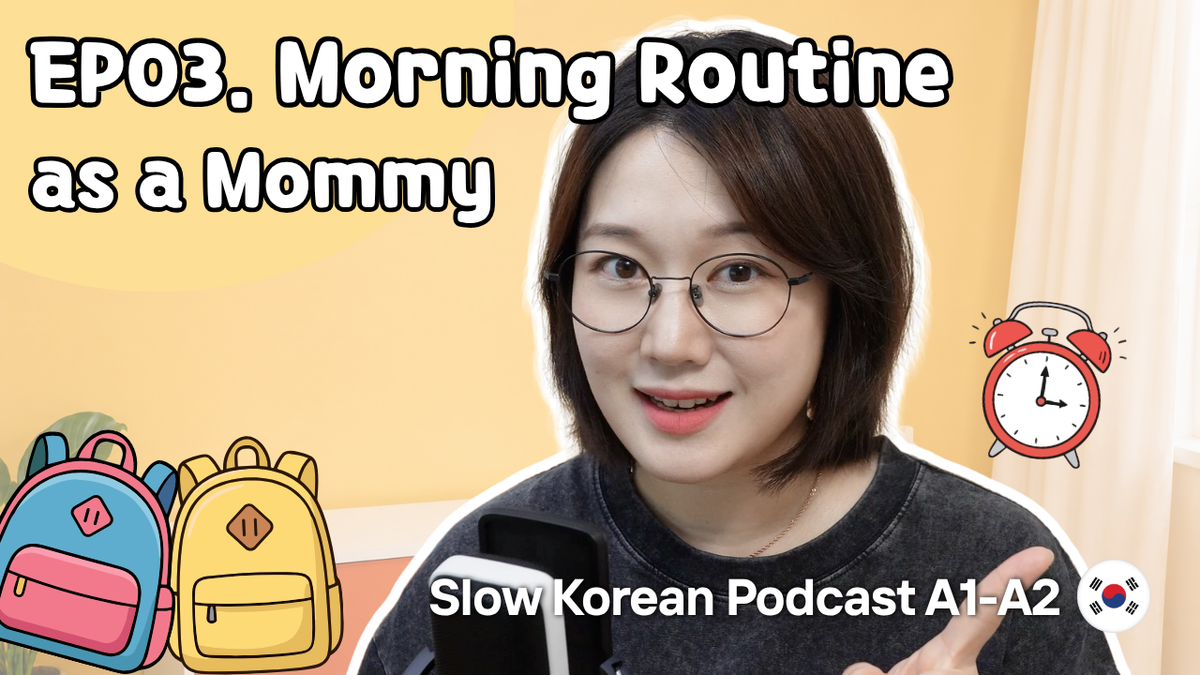
Easy Korean Podcast Ep. 3: A Korean Mom’s Morning Routine | 한국 엄마의 아침 일상
Follow a busy Korean mom’s morning and learn practical verbs and expressions for talking about your own daily routine.

What Korean word does a busy mom say more than ten times before 10 a.m.? 빨리—quickly!
In Episode 3 of YoungSsam’s Korean Podcast, follow my real morning as I get two children ready for school and daycare. This slow Korean story is filled with practical verbs and short expressions you can use to talk about your own daily routine.
Watch and listen to Episode 3 on YouTube →
What you’ll hear in this episode
- A real morning routine in a Korean family
- Getting children ready for school and 어린이집 (daycare)
- Useful everyday verbs for waking up, eating, washing, and getting dressed
- Natural family expressions such as 빨리 일어나! and 잘 다녀와
- A shadowing replay for another round of listening practice
Key Korean words and expressions
일어나다 — to wake up, get up
저는 아침 7시 30분에 일어나요.
I get up at 7:30 in the morning.
The phrase 일어나면 제일 먼저… is useful for describing the first thing you do after waking up:
일어나면 제일 먼저 이를 닦아요.
When I get up, the first thing I do is brush my teeth.
Now replace the final action:
일어나면 제일 먼저 물을 마셔요.
When I get up, the first thing I do is drink water.
준비하다 — to prepare
아이들이 먹을 아침밥을 준비해요.
I prepare breakfast for the children.
You can use the same verb for many parts of your morning:
학교 갈 준비를 해요.
I get ready to go to school.
출근할 준비를 해요.
I get ready for work.
깨우다 — to wake someone up
일어나다 means that you get up. 깨우다 means that you wake another person up.
아침 식사를 준비하고 나면 아이들을 깨워요.
After preparing breakfast, I wake the children up.
빨리 — quickly
In this episode, you’ll hear 빨리 again and again:
빨리 일어나!
Wake up quickly!
빨리 해!
Hurry up!
빨리 먹어!
Eat quickly!
빨리 가자!
Let’s go quickly!
These are casual expressions used with family or close friends. With someone you need to speak politely to, change the ending:
빨리 가요.
Let’s go / Please go quickly.
챙기다 — to pack, gather, or make sure you have something
챙기다 is one of the most useful Korean daily-life verbs.
아이들이 아침을 먹는 동안 저는 가방을 챙겨요.
While the children eat breakfast, I pack their bags.
물통을 챙겨요.
I pack the water bottle.
Try replacing the object with something you need:
우산을 챙겨요.
I make sure to take an umbrella.
지갑을 챙겨요.
I make sure to take my wallet.
다녀오겠습니다 / 잘 다녀와 — Goodbye at home
When someone leaves home for school or work, you may hear this short exchange:
다녀오겠습니다.
I’m leaving now and will come back.
잘 다녀와.
Have a good day / Come back safely.
This is a natural Korean family routine, not a literal word-for-word exchange in English.
Build your own morning routine
Use this simple frame:
아침에 일어나면 제일 먼저 __________.
When I wake up in the morning, the first thing I do is __________.
Choose an action that is true for you:
아침에 일어나면 제일 먼저 커피를 마셔요.
When I wake up, the first thing I do is drink coffee.
아침에 일어나면 제일 먼저 샤워해요.
When I wake up, the first thing I do is shower.
아침에 일어나면 제일 먼저 핸드폰을 봐요.
When I wake up, the first thing I do is check my phone.
One frame can become a sentence about your real life.
Try listening in three steps
- Listen once for the story. Don’t stop for every unfamiliar word. Follow what happens from waking up to daycare.
- Listen again with subtitles or the PDF transcript. Notice repeated verbs such as 일어나다, 먹다, 챙기다, and 가다.
- Use the shadowing replay. Repeat one beat behind the audio, then choose one sentence and change it to match your morning.
Download the free Korean transcript
Read along with the complete transcript, review the daily-life verbs, and use it for shadowing practice.
Download the free Episode 3 transcript PDF →
Your turn
How is your morning?
여러분의 아침은 어때요?
What is your morning like?
Complete this sentence and say it aloud:
아침에 일어나면 제일 먼저 __________.
Listen to a real routine. Find one useful sentence. Change it until it sounds like you.
![[Korean Sentence Pattern #05] N을/를 V-아요/어요 (Korean Object Particles)](https://storage.ghost.io/c/3e/77/3e77e67a-c356-4231-b7c2-8a02146832bb/content/images/size/w600/2026/10/eul-reul-feature.png)
![[Korean Sentence Pattern #04] V/A -아요/어요 (Everyday Polite Korean)](https://storage.ghost.io/c/3e/77/3e77e67a-c356-4231-b7c2-8a02146832bb/content/images/size/w600/2026/10/ayo-eoyo-feature-v2.png)
![[Korean Sentence Pattern #03] N이/가 없어요 (There isn’t / I don’t have)](https://storage.ghost.io/c/3e/77/3e77e67a-c356-4231-b7c2-8a02146832bb/content/images/size/w600/2026/09/-----------------------------------1.Png)