Easy Korean Podcast Ep. 2: First Conversations in Korea | 처음 나누는 대화
Learn the questions Koreans really ask when meeting someone for the first time—and practise answering them with your own information.

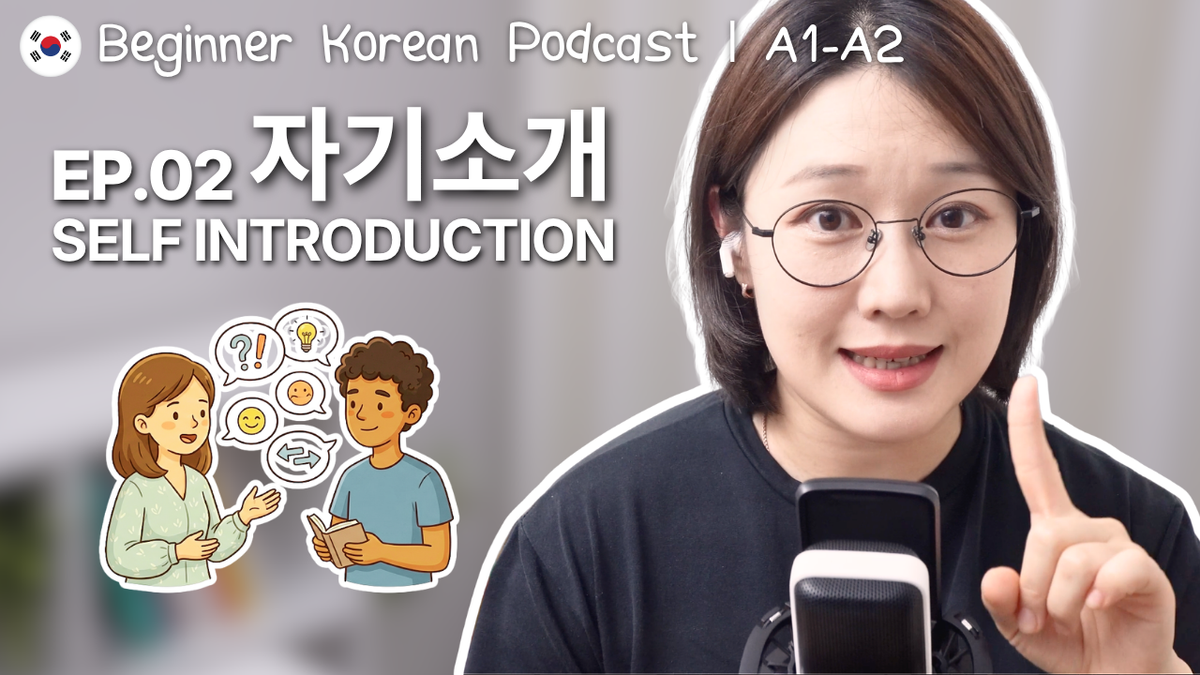
You may already know how to introduce yourself in Korean. But what happens when a Korean asks you a question?
In Episode 2 of YoungSsam’s Korean Podcast, you’ll learn the questions Koreans actually use when meeting someone for the first time—and how to answer them naturally and politely.
Watch and listen to Episode 2 on YouTube →
What you’ll learn in this episode
- Three expressions for greeting someone for the first time
- Natural ways to ask about someone’s name, age, country, and job
- The difference between textbook questions and expressions Koreans commonly use
- One important rule: never use honorific language for yourself
- A complete first-conversation practice
Start the conversation naturally
안녕하세요 — Hello
Use 안녕하세요 as your first greeting. You can say it to almost anyone at any time of day.
반갑습니다 — Nice to meet you
After saying hello, use 반갑습니다 to show that you are happy to meet the other person.
안녕하세요. 반갑습니다.
Hello. Nice to meet you.
잘 부탁드립니다 — I look forward to getting along with you
Koreans often say 잘 부탁드립니다 at the end of an introduction. There is no perfect English translation, so it is best to learn it as one useful greeting expression.
저는 영쌤이에요. 서울에서 왔어요. 잘 부탁드립니다.
I’m YoungSsam. I’m from Seoul. I look forward to getting along with you.
Four questions Koreans really ask
1. 성함이 어떻게 되세요? — May I ask your name?
You may have learned 이름이 뭐예요? This is fine with someone around your age or younger. When you want to sound more polite, Koreans often ask:
성함이 어떻게 되세요?
May I ask your name?
Answer with:
제 이름은 제니예요.
My name is Jenny.
Important: Do not say 제 성함은… The word 성함 is an honorific word for someone else’s name, not your own.
2. 나이가 어떻게 되세요? — How old are you?
몇 살이에요? can sound too direct when you ask an adult you have just met. A more polite question is:
나이가 어떻게 되세요?
How old are you?
Among people who seem close in age, you may also hear:
몇 년생이에요?
What year were you born?
You can answer:
저는 스물다섯 살이에요.
I’m twenty-five years old.
저는 97년생이에요.
I was born in 1997.
3. 어디에서 오셨어요? — Where are you from?
어느 나라 사람이에요? is correct, but Koreans often use this more natural question:
어디에서 오셨어요?
Where are you from?
Answer with 왔어요, not 오셨어요:
저는 미국에서 왔어요.
I’m from the United States.
오셨어요 politely raises the person you are speaking to. You do not use that honorific form for yourself.
4. 무슨 일 하세요? — What do you do?
Instead of the textbook-style question 직업이 뭐예요?, Koreans commonly ask:
무슨 일 하세요?
What kind of work do you do?
You can answer simply:
저는 학생이에요.
I’m a student.
저는 회사원이에요.
I’m an office worker.
Build your first conversation
Now connect the questions and answers:
A: 안녕하세요. 반갑습니다!
B: 안녕하세요! 반갑습니다.
A: 성함이 어떻게 되세요?
B: 제 이름은 제니예요.
A: 어디에서 오셨어요?
B: 저는 뉴욕에서 왔어요.
A: 무슨 일 하세요?
B: 저는 학생이에요.
Don’t memorize the whole dialogue. Replace 제니, 뉴욕, and 학생 with your own information. That is how you turn a model conversation into your Korean.
Try listening in three steps
- Listen without the transcript. Focus on recognizing the four questions.
- Listen again with Korean subtitles or the PDF. Connect the written phrases with the sounds you hear.
- Pause after each question and answer aloud. Use your real name, country, age, and job.
Download the free Korean transcript
Use the complete PDF transcript to read along, review every expression, and practise the full conversation.
Download the free Episode 2 transcript PDF →
Your turn
Answer these questions aloud:
- 성함이 어떻게 되세요?
- 어디에서 오셨어요?
- 나이가 어떻게 되세요?
- 무슨 일 하세요?
Then choose one question and ask it in the comments.
Listen to the question. Answer with your own information.
Speak your Korean—not a memorized textbook dialogue.
![[Korean Sentence Pattern #05] N을/를 V-아요/어요 (Korean Object Particles)](https://storage.ghost.io/c/3e/77/3e77e67a-c356-4231-b7c2-8a02146832bb/content/images/size/w600/2026/10/eul-reul-feature.png)
![[Korean Sentence Pattern #04] V/A -아요/어요 (Everyday Polite Korean)](https://storage.ghost.io/c/3e/77/3e77e67a-c356-4231-b7c2-8a02146832bb/content/images/size/w600/2026/10/ayo-eoyo-feature-v2.png)
![[Korean Sentence Pattern #03] N이/가 없어요 (There isn’t / I don’t have)](https://storage.ghost.io/c/3e/77/3e77e67a-c356-4231-b7c2-8a02146832bb/content/images/size/w600/2026/09/-----------------------------------1.Png)