Complete Guide for Korean Pronunciation: ㄱ, ㅋ, ㄲ

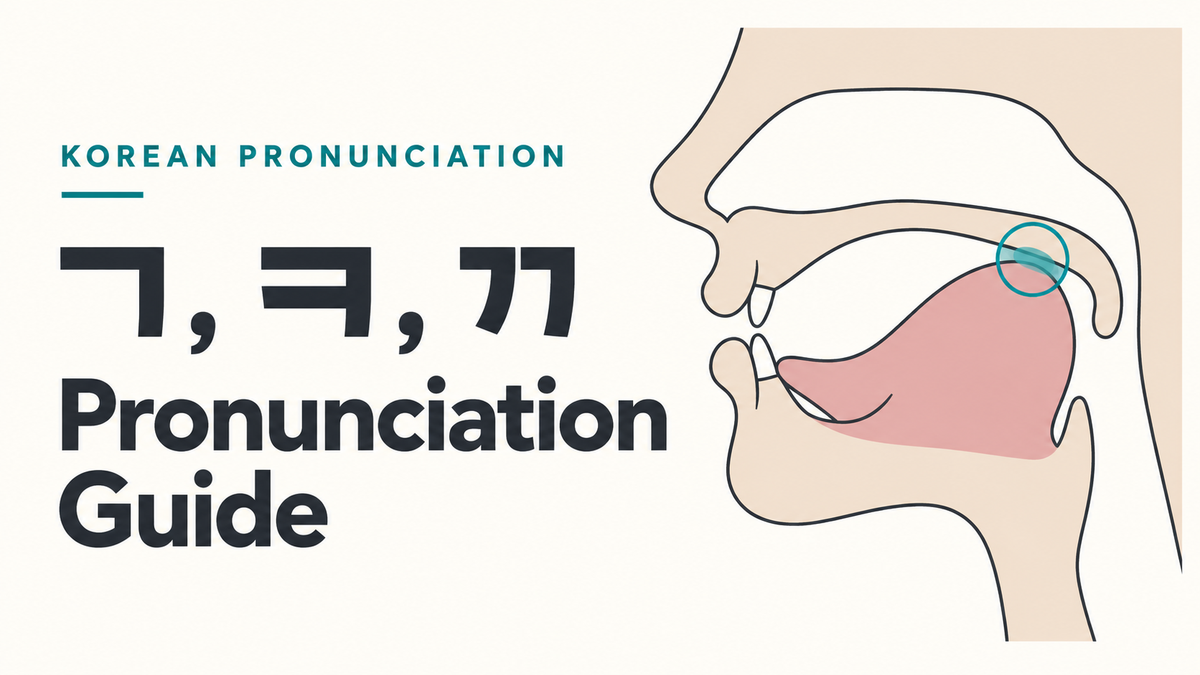
Does 가게 sound like “kage” to you? That’s natural. Here’s why—and what to practice.
If you learned that ㄱ is “g” and ㅋ is “k,” Korean pronunciation can feel confusing. Why does the first ㄱ in 고기 sound like “k,” while the second sounds like “g”?
Korean sounds don’t fit neatly into English spelling.
To hear and pronounce ㄱ, ㅋ, and ㄲ, pay attention to how each sound starts: the airflow, the tension, and the voice.
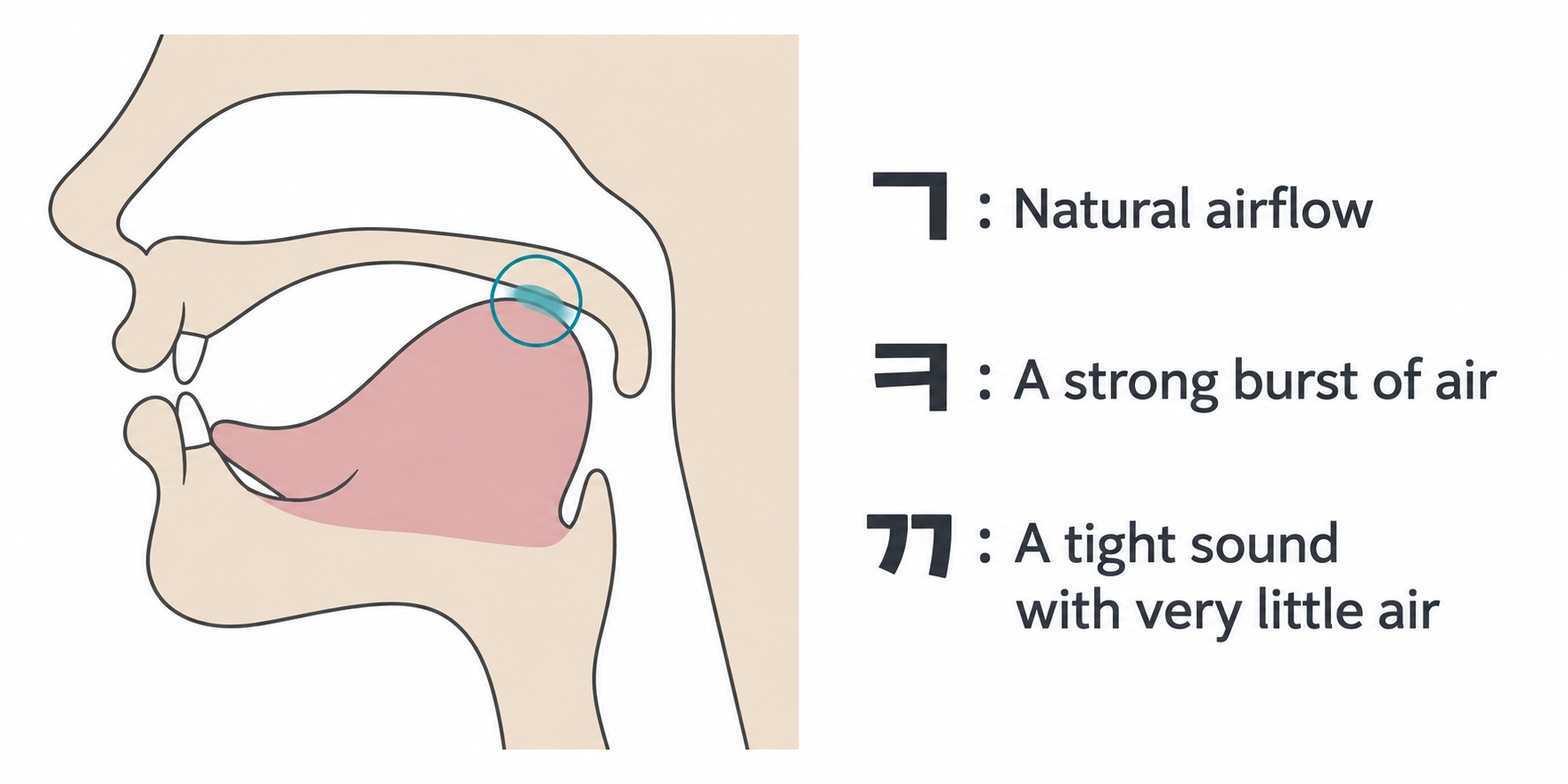
ㄱ, ㅋ, and ㄲ are all made in the same place in your mouth. The back of your tongue touches the soft palate—the soft part at the back of the roof of your mouth—briefly blocking the air, then releases it. The difference is in how you release the sound.
Why ㄱ can sound like both “k” and “g”
When you say a word on its own, the first ㄱ is usually voiceless: your vocal cords aren’t vibrating during the consonant. It may sound like an English “k.” This doesn’t mean you’re saying ㅋ.
Later in the word, especially between vowels, ㄱ naturally becomes voiced. Your vocal cords vibrate, making it sound more like an English “g.”
- 가게 (store) → “kage”
- 고기 (meat) → “kogi”
- 기계 (machine) → “kigye”
These are listening guides, not exact phonetic spellings. It is natural for 가게 to sound like “kage” and 고기 to sound like “kogi.”
A useful beginner pattern is “k-like at the beginning, g-like later.” But it isn’t simply a rule about syllable numbers. The surrounding sounds matter: ㄱ doesn’t automatically become voiced in every second or later syllable.
Korean speakers hear both as ㄱ
To an English-speaking learner, the two ㄱ sounds in 가게 may seem like different consonants. Korean speakers normally hear them as versions of the same consonant, ㄱ.
The difference is real, but it doesn’t create a separate consonant category in Korean. You don’t need to force the first ㄱ to sound like an English “g.”
How are ㅋ and ㄲ different?
- ㄱ: Start relatively relaxed.
- ㅋ: Deliberately release a stronger puff of air.
- ㄲ: Start firmly, with more tension and very little escaping air.
A helpful way to practice ㄱ and ㅋ is to keep ㄱ relaxed and give ㅋ a deliberate, stronger puff of air. For ㄲ, make a firm, tight start with very little air.
For ㅋ, think “an extra burst of breath,” rather than simply “a louder k.” For ㄲ, think “a compact, firm start.” Don’t try to make it by blowing harder.
These correspond to Korean’s plain, aspirated, and tense consonants.
Practice 1: Separate the two “k-like” beginnings
An important practice target is the difference between word-initial ㄱ and ㅋ. Both may sound like “k” at first, so labeling them “g” and “k” won’t help much.
Say these slowly:
가 — 카 — 까
고 — 코 — 꼬
기 — 키 — 끼
Hold your palm in front of your mouth. Give ㅋ a noticeable puff of air, and keep ㄲ firm and compact. ㄱ can also release some air, so don’t aim for “absolutely no air.”
Use airflow as a starting cue, then listen to a native speaker and copy the whole syllable, including its pitch.
Practice 2: Let ㄱ change naturally inside a word
가게 — 가게 — 가게
고기 — 고기 — 고기
기계 — 기계 — 기계
Say each word smoothly instead of separating its syllables. Let the first ㄱ sound k-like and the next ㄱ sound more g-like.
If 가게 sounds like “kage” and 고기 sounds like “kogi,” that’s natural.
Practice 3: Put all three into one sentence
가끔 커피를 마셔요.
I sometimes drink coffee.
- 가 in 가끔: a relaxed ㄱ.
- 끔 in 가끔: a firm ㄲ with little airflow.
- 커 in 커피: a ㅋ with a clear puff of air.
Start with 가끔 / 커피를 / 마셔요, then connect the phrase naturally. Record yourself and compare it with a native-speaker recording.
Your goal is to hear and produce three different beginnings: ㄱ, ㅋ, and ㄲ. Practicing their contrast will help more than trying to assign each one an English letter.
Want to Connect with Other Korean Learners?
Join the YoungSsam Korean Club, a community where you can learn and practice Korean with YoungSsam and fellow learners.
Find Hangul lessons, pronunciation tips, useful Korean expressions, and speaking practice—all in one place. You can also join YoungSsam’s reading and sentence-building challenges to turn what you learn into Korean you can actually use.