🎨 Colors in Korean - How to use in sentences
Go beyond color names! Learn how to say what color something is, describe color changes, and put colors before nouns—with Korean examples and a downloadable PDF.

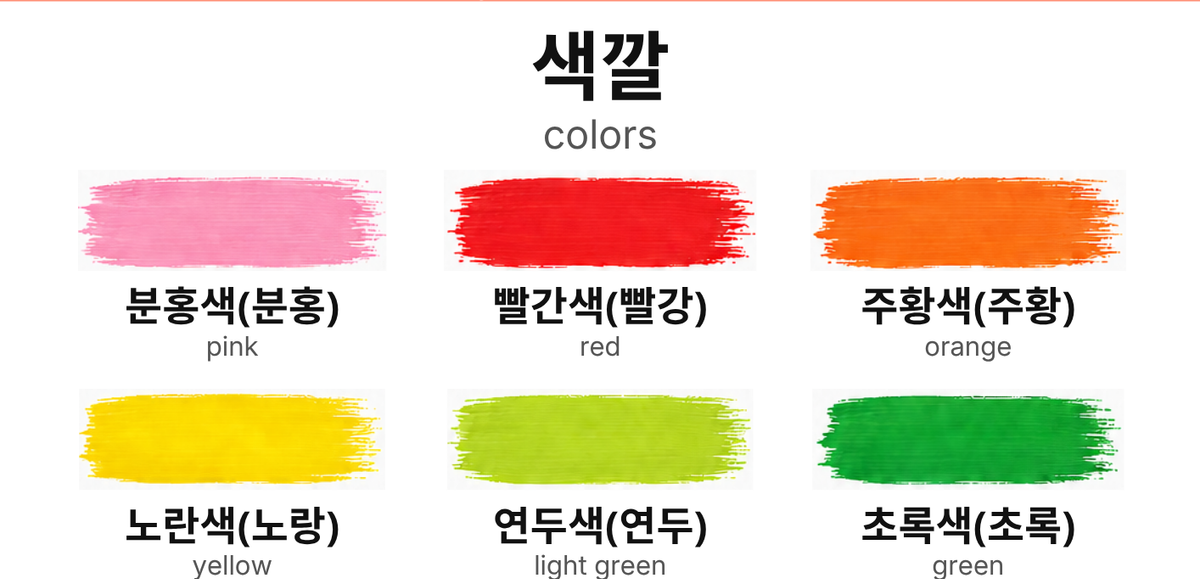
빨간색, 노란색, 파란색… How many Korean color words do you know?
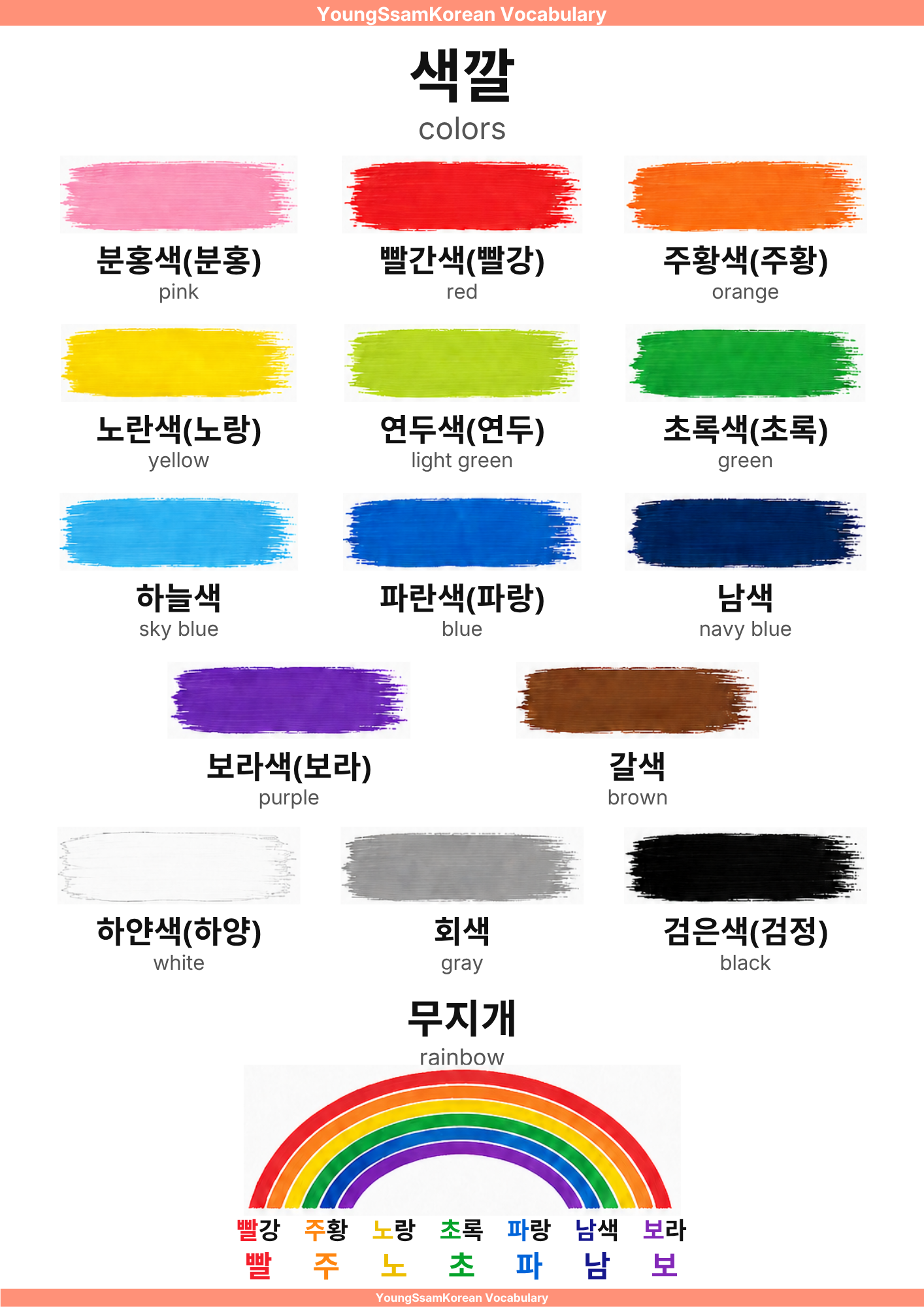
Start with the image below to learn the basic names. Then take the next step: use them in sentences!
First, color names and color adjectives
In Korean, some colors have both a noun and an adjective, while others are usually expressed using just the color noun.
For example, 빨간색 is the name of a color—a noun meaning “red.” 빨갛다 is an adjective meaning “to be red.”
| Color noun | Color adjective |
|---|---|
| 빨간색 — red | 빨갛다 |
| 노란색 — yellow | 노랗다 |
| 파란색 — blue | 파랗다 |
| 하얀색 — white | 하얗다 |
| 검은색 — black | 검다 / 까맣다 |
When you look up a Korean color adjective in a dictionary, its basic form ends in -다. Its form changes depending on how you use it in a sentence.
빨갛다 → 빨개요 / 빨갛게 / 빨간
But you can’t turn every color name into an adjective simply by adding -다. 초록다 and 연두다 aren’t Korean words. For these colors, use the color noun.
- 나뭇잎이 초록색이에요. ✅
The leaves are green. - 나뭇잎이 초록다. ❌
- 연두색 가방을 샀어요. ✅
I bought a light green bag.
So when you learn a color name, it helps to learn whether it has a corresponding adjective, too.
Now, let’s make sentences in three different ways!
1. “What color is it?” — Saying what color something is
The simplest pattern is color noun + 이에요.
- 사과는 빨간색이에요.
The apple is red. - 나뭇잎이 초록색이에요.
The leaves are green. - 이 가방은 보라색이에요.
This bag is purple.
If the color has an adjective, such as 빨갛다, 노랗다, or 파랗다, you can also use its polite -아요/어요 form.
- 사과는 빨개요.
The apple is red. - 바나나는 노래요.
The banana is yellow. - 하늘이 파래요.
The sky is blue. - 눈이 하얘요.
The snow is white. - 고양이가 까매요.
The cat is black.
사과는 빨간색이에요.
사과는 빨개요.
Both are natural ways to say “The apple is red.” You can use the color’s name or describe it with an adjective.
2. “How did it change?” — Describing a change or an action
Use the adjective stem—the part before -다—and add -게 to describe the color something becomes, or the color an action makes it.
빨갛다 → 빨갛게
노랗다 → 노랗게
하얗다 → 하얗게
- 가을이 되어서 나뭇잎이 노랗게 변했어요.
The leaves turned yellow when autumn came. - 부끄러워서 얼굴이 빨갛게 됐어요.
My face turned red because I was embarrassed. - 벽을 하얗게 칠했어요.
I painted the wall white.
When using a color noun ending in 색, add -으로 instead.
- 벽을 분홍색으로 칠했어요.
I painted the wall pink. - 나뭇잎이 갈색으로 변했어요.
The leaves turned brown.
벽을 하얗게 칠했어요.
벽을 하얀색으로 칠했어요.
Both mean “I painted the wall white.” Here, too, you have two ways to express the same idea!
3. “What kind of sky do you like?” — Describing a noun directly
You can place a color adjective before a noun to describe its color. To do this, change its form to 빨간, 노란, 파란, 하얀, or 까만.
- 파란 하늘을 좋아해요.
I like blue skies. - 빨간 사과를 먹었어요.
I ate a red apple. - 노란 꽃이 피었어요.
A yellow flower bloomed. - 하얀 셔츠를 입었어요.
I wore a white shirt. - 까만 고양이가 자고 있어요.
A black cat is sleeping.
You can also put a color noun directly before another noun.
- 초록색 나뭇잎이 보여요.
I can see green leaves. - 분홍색 꽃을 샀어요.
I bought pink flowers. - 보라색 가방을 좋아해요.
I like purple bags.
Both 빨간 사과 and 빨간색 사과 mean “a red apple.” But since there’s no adjective 초록다, you can use 초록색 사과 for “a green apple.”
At a glance
| Dictionary form | Ending a sentence | Describing an action or change | Before a noun |
|---|---|---|---|
| 빨갛다 | 빨개요 | 빨갛게 | 빨간 사과 |
| 노랗다 | 노래요 | 노랗게 | 노란 꽃 |
| 파랗다 | 파래요 | 파랗게 | 파란 하늘 |
| 하얗다 | 하얘요 | 하얗게 | 하얀 셔츠 |
| 까맣다 | 까매요 | 까맣게 | 까만 고양이 |
You can use color nouns in all three ways, too:
분홍색이에요 → 분홍색으로 칠했어요 → 분홍색 꽃
It’s pink. → I painted it pink. → A pink flower.
Your turn!
Choose something around you and say what color it is. Then use that color to describe the object directly.
하늘이 파래요.
The sky is blue.
→ 파란 하늘을 좋아해요.
→ I like blue skies.
이 가방은 보라색이에요.
This bag is purple.
→ 보라색 가방을 샀어요.
→ I bought a purple bag.
It’s completely fine to check the PDF as you practice. Once you know a color word, you can use it in several different sentence patterns!
In the next post, we’ll explore how Korean adds different feelings to color words. 🎨
![[Korean Sentence Pattern #05] N을/를 V-아요/어요 (Korean Object Particles)](https://storage.ghost.io/c/3e/77/3e77e67a-c356-4231-b7c2-8a02146832bb/content/images/size/w600/2026/10/eul-reul-feature.png)
![[Korean Sentence Pattern #04] V/A -아요/어요 (Everyday Polite Korean)](https://storage.ghost.io/c/3e/77/3e77e67a-c356-4231-b7c2-8a02146832bb/content/images/size/w600/2026/10/ayo-eoyo-feature-v2.png)
![[Korean Sentence Pattern #03] N이/가 없어요 (There isn’t / I don’t have)](https://storage.ghost.io/c/3e/77/3e77e67a-c356-4231-b7c2-8a02146832bb/content/images/size/w600/2026/09/-----------------------------------1.Png)