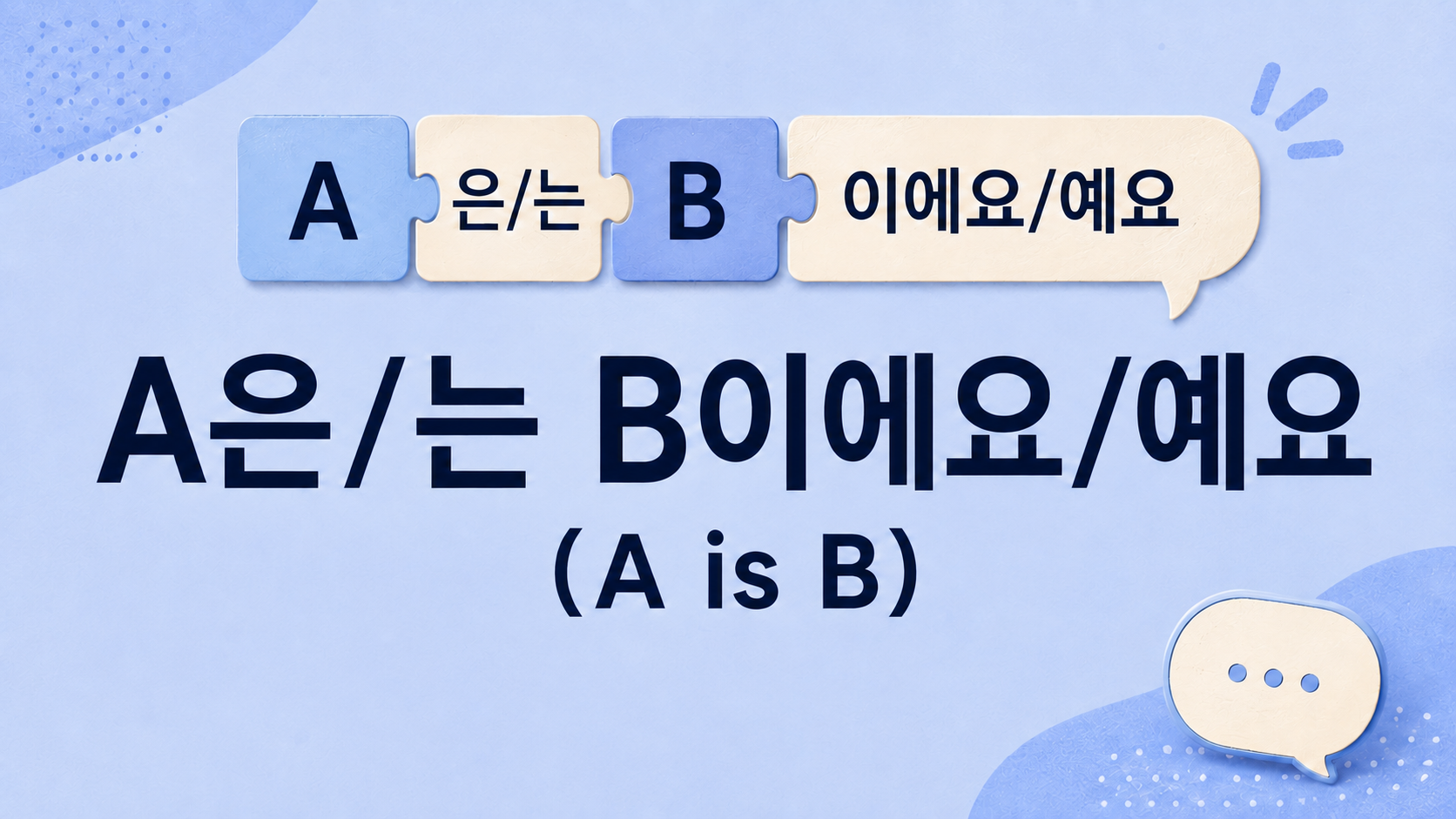
[Korean Sentence Pattern #01] A은/는 B이에요/예요 (A is B)
Learn how to say “A is B” in Korean with 은/는 and 이에요/예요. Then replace the nouns to build Korean sentences that express who you are.

![[Korean Sentence Pattern #01] A은/는 B이에요/예요 (A is B)](https://storage.ghost.io/c/3e/77/3e77e67a-c356-4231-b7c2-8a02146832bb/content/images/size/w1200/2026/09/exec-bfddaa84-e416-42a1-9823-581d66d34b4e-2.png)
Want to introduce yourself in Korean?
You don’t need to memorize a long textbook dialogue. Start with one simple sentence pattern, then add the words that describe you.
A은/는 B이에요/예요.
A is B.
With this pattern, you can talk about your name, job, nationality, hobbies, and much more.
Start with this sentence
저는 영쌤이에요.
I’m YoungSsam.
Let’s break it into three parts:
- 저 = I, me
- 는 = marks “저” as the topic
- 영쌤이에요 = am YoungSsam
저 + 는 becomes 저는.
You can think of 은/는 as showing what the sentence is about:
저는 학생이에요.
As for me, I’m a student.
In natural English, we simply translate it as “I’m a student.”
The sentence-building pattern
Use this frame:
저는 + N + 이에요/예요.
I am + noun.
Replace N with a noun that describes you.
- 학생 → 저는 학생이에요. — I’m a student.
- 선생님 → 저는 선생님이에요. — I’m a teacher.
- 가수 → 저는 가수예요. — I’m a singer.
- 요리사 → 저는 요리사예요. — I’m a cook.
You are not memorizing four separate sentences. You are learning one pattern and changing the word inside it.
이에요 or 예요?
Both 이에요 and 예요 work like “am,” “is,” or “are.” Your choice depends on the final sound of the noun.
After a final consonant: 이에요
If the noun ends in a consonant sound, add 이에요.
학생 + 이에요 → 학생이에요
선생님 + 이에요 → 선생님이에요
회사원 + 이에요 → 회사원이에요
The final consonant at the bottom of a Korean syllable is called 받침.
- 학생 → has 받침 ㅇ → 학생이에요
- 선생님 → has 받침 ㅁ → 선생님이에요
After a vowel: 예요
If the noun ends in a vowel sound, add 예요.
가수 + 예요 → 가수예요
의사 + 예요 → 의사예요
요리사 + 예요 → 요리사예요
- 가수 → no 받침 → 가수예요
- 의사 → no 받침 → 의사예요
Here is the quick rule:
받침 O → 이에요
받침 X → 예요
Don’t stop for too long to calculate the rule while speaking. With repeated practice, the correct form will begin to sound natural.
Now make the sentence yours
Choose a word that actually describes you.
Jobs and identities
- 학생 — student
- 대학생 — university student
- 선생님 — teacher
- 회사원 — office worker
- 연구원 — researcher
- 의사 — doctor
- 변호사 — lawyer
- 배우 — actor
- 유튜버 — YouTuber
- 요리사 — cook
Now add your word to the frame:
저는 __________이에요/예요.
For example:
저는 회사원이에요.
I’m an office worker.
저는 연구원이에요.
I’m a researcher.
저는 배우예요.
I’m an actor.
저는 유튜버예요.
I’m a YouTuber.
Which sentence sounds like you?
Build more than a job sentence
The same pattern can introduce other information too.
제 이름은 마리아예요.
My name is Maria.
제 취미는 요리예요.
My hobby is cooking.
제가 제일 좋아하는 음식은 김밥이에요.
My favorite food is gimbap.
The words become more detailed, but the ending follows the same rule:
- 마리아 → vowel → 마리아예요
- 요리 → vowel → 요리예요
- 김밥 → final consonant → 김밥이에요
That is how one small pattern starts growing into your Korean.
Ask someone a question
You can also use 뭐예요? to ask what something is.
이름이 뭐예요?
What’s your name?
직업이 뭐예요?
What’s your job?
취미가 뭐예요?
What’s your hobby?
Try answering with today’s pattern:
이름이 뭐예요?
제 이름은 알렉스예요. (My name is Alex)
직업이 뭐예요?
저는 대학생이에요. (I am an university student)
취미가 뭐예요?
제 취미는 독서예요. (My hobby is reading books)
You don’t need to understand every particle in these questions yet. For now, notice the pattern and practise using it as one useful chunk.
Your turn: build three sentences
Complete these sentences with information about yourself.
- 제 이름은 __________이에요/예요.
- 저는 __________이에요/예요.
- 제 취미는 __________이에요/예요.
Then say each sentence aloud three times.
First, read it slowly.
Next, say it without looking.
Finally, imagine you are meeting someone for the first time and say it naturally.
One pattern, your Korean
A textbook might give you this sentence:
저는 학생이에요.
I’m a student.
But what if you aren’t a student?
Don’t memorize a sentence you’ll never use. Keep the pattern and replace the noun:
저는 + your word + 이에요/예요.
That is the goal: not simply repeating someone else’s Korean, but building a sentence that expresses who you are.
Build your own sentence. Speak YOUR Korean, not textbook Korean.
![[Korean Sentence Pattern #05] N을/를 V-아요/어요 (Korean Object Particles)](https://storage.ghost.io/c/3e/77/3e77e67a-c356-4231-b7c2-8a02146832bb/content/images/size/w600/2026/10/eul-reul-feature.png)
![[Korean Sentence Pattern #04] V/A -아요/어요 (Everyday Polite Korean)](https://storage.ghost.io/c/3e/77/3e77e67a-c356-4231-b7c2-8a02146832bb/content/images/size/w600/2026/10/ayo-eoyo-feature-v2.png)
![[Korean Sentence Pattern #03] N이/가 없어요 (There isn’t / I don’t have)](https://storage.ghost.io/c/3e/77/3e77e67a-c356-4231-b7c2-8a02146832bb/content/images/size/w600/2026/09/-----------------------------------1.Png)